
Target Corporation is one of the largest retail companies in the United States, operating a nationwide network of stores, distribution facilities, and digital shopping services. Its workforce plays a central role in keeping stores stocked, fulfilling online orders, assisting customers, managing supply chains, and supporting the company’s broader business operations.
One of the most common questions about the retailer is: about how many employees does target corporation employ? The answer depends on the reporting period, the company’s official workforce disclosures, and whether the figure refers to employees worldwide, full-time staff, part-time workers, or people employed during the busy holiday season.
Target’s workforce is particularly interesting because it combines traditional retail positions with technology, logistics, merchandising, finance, marketing, and corporate management. Understanding the company’s employee count therefore provides more than a simple headcount: it offers insight into the scale of its operations, its role in the American labor market, and the challenges of managing a large retail workforce.
This article examines Target Corporation’s employee count, workforce structure, employment categories, business operations, hiring practices, seasonal staffing, and the factors that can cause its reported workforce numbers to change.
1. Target Corporation Employee Count in 2026
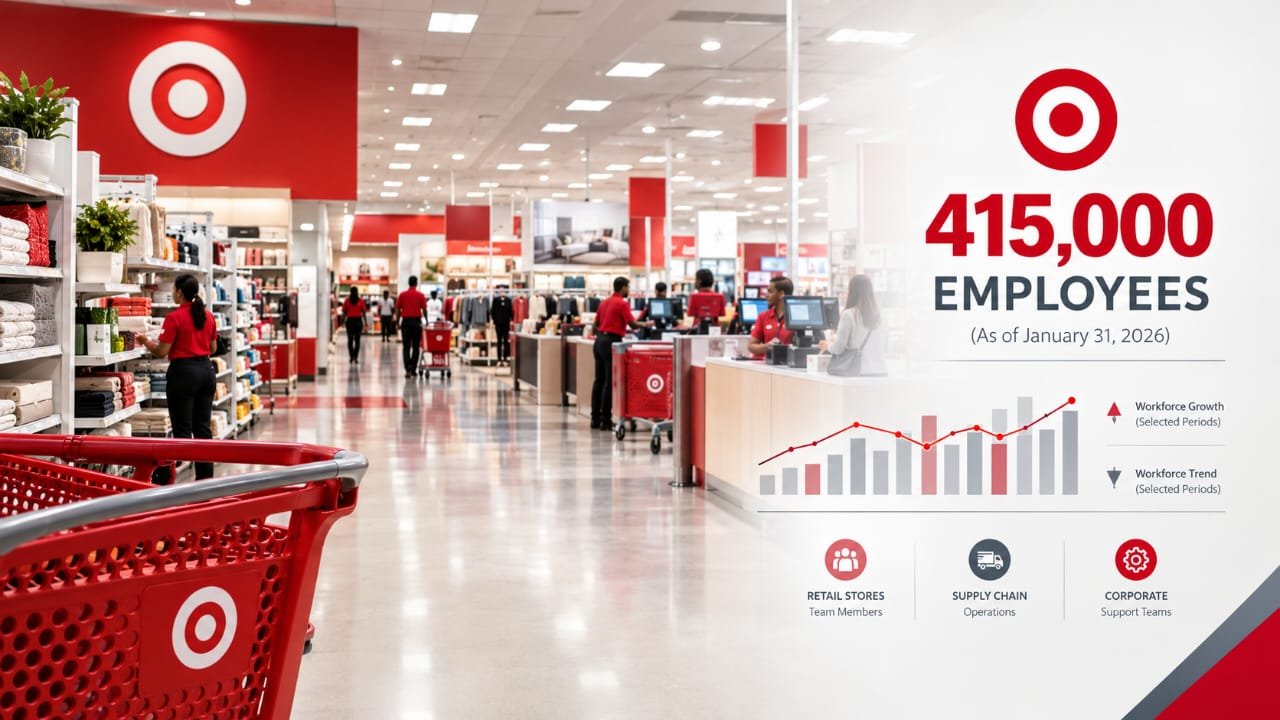
According to Target Corporation’s 2025 annual report, the company employed approximately 415,000 full-time, part-time, and seasonal team members as of January 31, 2026. This is the most recent annual workforce figure available for this article.
Target Corporation
+1
In simple terms, Target employs roughly 415,000 people across its retail and supporting operations. This makes it one of the major private-sector employers in the United States.
The figure includes employees with different working arrangements. Some work full-time throughout the year, while others work part-time or join the company temporarily during periods of increased demand. The total should therefore not be interpreted as 415,000 full-time positions.
The question of about how many employees does target corporation employ? is best answered by using the company’s official reporting date rather than relying on estimates from job websites or older articles.
TARGET CORPORATION — WORKFORCE SNAPSHOT
415,000 employees
Reported as of January 31, 2026
Workforce categories
Full-time, part-time, and seasonal team members
U.S. retail network
1,995 stores reported for 2025
Seasonal variation
Employment levels generally peak during the holiday season
Source: Target Corporation’s 2025 annual report and corporate investor overview.
Target Corporation
+2
Why the number matters
An employee count is one of the simplest ways to understand the scale of a large business. For Target, the figure reflects the people needed to operate stores, move merchandise, process orders, manage inventory, maintain technology systems, and coordinate corporate functions.
A retailer with hundreds of thousands of employees must coordinate staffing across many locations and job categories. It must also balance labor costs against customer demand, product availability, operating hours, and sales performance.
Target’s headcount also matters to job seekers, investors, business researchers, suppliers, and people studying the American retail industry. It helps indicate the company’s employment footprint, although headcount alone does not reveal the quality of individual jobs, average pay, employee satisfaction, or overall productivity.
2. Target Corporation Biography and Company Profile
Target Corporation is an American general merchandise retailer headquartered in Minneapolis, Minnesota. It sells products across categories such as food and beverages, clothing, household essentials, beauty, electronics, toys, home furnishings, and seasonal merchandise.
The company’s business combines physical stores with online shopping and order-fulfillment services. Its stores are not simply places where customers purchase goods; they also support many digital orders through pickup, drive-up, and delivery options.
Target Corporation biography table
| Detail | Information |
|---|---|
| Company name | Target Corporation |
| Common brand name | Target |
| Industry | Retail and general merchandise |
| Headquarters | Minneapolis, Minnesota, United States |
| Historical roots | Dayton Dry Goods Company, founded in 1902 |
| Target store brand introduced | 1962 |
| Public stock symbol | TGT |
| Stock exchange | New York Stock Exchange |
| Primary market | United States |
| Main business | Stores, digital retail, merchandise, and related services |
| Employees | Approximately 415,000 |
| Employee-count date | January 31, 2026 |
| U.S. store count | 1,995 in 2025 |
| CEO listed in the 2025 annual report | Michael J. Fiddelke |
| Fiscal year covered by the latest workforce figure | Fiscal 2025 |
| Workforce categories | Full-time, part-time, and seasonal employees |
The historical and corporate details above are drawn from Target’s corporate reporting and company history. The employee count and store count refer to different reporting dates and should be read accordingly.
Target Corporation
+3
Target’s origins and development
Target’s corporate history traces back to the Dayton Dry Goods Company, established in Minneapolis in 1902. The Target discount-store concept was introduced in 1962, creating the foundation for the recognizable retail brand that operates today.
Over time, the company developed from a traditional store-based retailer into a large business that integrates physical retail, digital commerce, distribution, and specialized services. That transformation increased the range of skills required across its workforce.
Modern retail depends on more than sales associates and cashiers. It also requires specialists in data analysis, inventory planning, cybersecurity, software development, merchandising, logistics, marketing, and customer experience.
The growth of these functions helps explain why Target’s workforce encompasses so many occupations beyond the visible activity inside its stores.
What makes Target a major employer?
Target operates a large network of U.S. stores and uses its existing locations to support digital fulfillment. Its scale creates demand for employees who handle both customer-facing activities and the behind-the-scenes work required to keep products moving.
For example, a customer ordering an item online may depend on several employees working in different roles: a team member maintaining inventory, a worker picking the order, another person coordinating pickup or delivery, and support staff maintaining the technology that connects these activities.
The company’s employee count reflects this interconnected operating model.
3. How Target’s Employee Count Has Changed Over Time
Target’s workforce has changed as its business, sales patterns, operating model, and staffing requirements have evolved. Annual employee figures provide a useful historical comparison, but they are snapshots taken at specific dates rather than an exact count of everyone who worked for the company throughout a year.
The following figures are reported in Target’s annual disclosures and summarized in historical employee-count records.
SEC
+3
| Reporting year | Approximate employees |
|---|---|
| 2018 | 345,000 |
| 2019 | 360,000 |
| 2020 | 368,000 |
| 2021 | 409,000 |
| 2022 | 450,000 |
| 2023 | 440,000 |
| 2024 | 415,000 |
| 2025 | 440,000 |
| 2026 | 415,000 |
Note: Figures are associated with each fiscal year’s reported workforce snapshot. They are not average annual employment figures.
Workforce growth before 2020
In the years before 2020, Target’s employee count generally increased. The company continued operating and developing its stores while investing in services that supported its retail business.
A growing store network can require more employees in sales, replenishment, management, security, and customer service. Expansion in digital retail can create additional staffing needs in order fulfillment, technology, distribution, and delivery coordination.
However, workforce growth does not always match store growth directly. New technology, different store formats, changing customer behavior, and improvements in operating processes can all influence the number of employees required.
The pandemic-era expansion
Target’s employee count rose significantly during the early 2020s, reaching approximately 450,000 in the reporting period associated with 2022. The expansion occurred during a period of substantial changes in shopping behavior and retail operations.
MacroTrends
+1
The pandemic accelerated the importance of online shopping, pickup services, and rapid order fulfillment. Retailers had to adapt to shifting demand, product availability challenges, health precautions, and changing customer expectations.
It would be too simplistic to attribute every workforce increase to one factor. Business growth, seasonal staffing, changing operating needs, and the timing of workforce measurements can all affect annual totals.
Why the reported figure declined in 2023 and 2024
The reported count fell from approximately 450,000 in 2022 to 440,000 in 2023 and 415,000 in 2024. It then rose to 440,000 in 2025 before declining to 415,000 in 2026.
MacroTrends
+1
These changes illustrate why employee statistics should be interpreted with care. A lower year-end headcount does not automatically mean that the company experienced a proportional decline in sales, store activity, or total hours worked.
Headcount can change when temporary positions end, employees leave, hiring slows, organizational structures change, or certain tasks are performed more efficiently. Changes in the timing of the reporting date and the composition of the workforce may also influence comparisons.
The latest reported figure is therefore the most appropriate answer to about how many employees does target corporation employ? for readers seeking the company’s current annual disclosure.
4. Where Do Target Corporation’s Employees Work?
Target’s approximately 415,000 employees work across different business functions, locations, and levels of responsibility. The company does not simply divide its workforce between cashiers and managers. Its operating model requires a broad network of people who coordinate product selection, store operations, distribution, digital commerce, and business administration.
Target’s public workforce figure does not provide a complete breakdown of the 415,000 employees by department, occupation, or employment status. The following sections explain the main functions that contribute to the company’s operations without presenting unsupported departmental headcounts.
Store operations and customer service
Store-based employees are among the most visible members of Target’s workforce. They help customers find merchandise, maintain organized shopping areas, replenish shelves, operate checkout systems, and ensure that stores are ready for daily business.
Typical store roles include:
- Sales floor team members who help customers and maintain product displays.
- Cashiers and checkout specialists who process transactions.
- Guest service representatives who handle returns, questions, and customer concerns.
- Fulfillment team members who pick and prepare online orders.
- Inventory and replenishment workers who move merchandise from storage areas to shelves.
- Department specialists who maintain particular product categories.
- Store leaders who coordinate staffing, performance, safety, and daily operations.
These jobs require a combination of practical skills, communication, attention to detail, and the ability to respond to changing customer needs.
Store employees also contribute to the shopping experience in ways that are difficult to measure through sales figures alone. A clean aisle, accurate product information, an efficiently handled return, or a correctly prepared pickup order can affect whether customers choose to return.
Distribution and supply-chain operations
Before merchandise reaches store shelves, it must move through a complex supply chain. Target relies on logistics and distribution operations to receive products, organize inventory, move goods between facilities, and deliver merchandise where it is needed.
Supply-chain employees may work in distribution centers, warehouses, transportation coordination, inventory planning, and logistics management.
Their responsibilities can include unloading shipments, sorting products, preparing pallets, operating approved equipment, monitoring inventory, and coordinating the movement of goods between locations.
The work is especially important during high-demand periods. If a popular product is unavailable, a store may lose a sale even when customers are ready to buy it. Effective inventory planning helps the company match product availability with local demand.
Supply-chain operations also influence the customer experience. Faster replenishment can improve shelf availability, while reliable distribution helps stores prepare for promotions and seasonal shopping peaks.
Headquarters and corporate employees
Target’s Minneapolis headquarters supports the broader organization through strategic planning, finance, human resources, legal services, communications, merchandising, and other corporate functions.
Corporate employees help establish business priorities, develop operating policies, manage budgets, evaluate performance, and coordinate decisions across the company.
Human resources specialists support recruitment, training, employee relations, benefits administration, and workforce planning. Finance professionals monitor costs and financial performance. Legal and compliance teams help the company understand and manage its obligations.
Corporate teams also work with store leaders and supply-chain specialists to translate company-wide goals into practical operating plans.
Although corporate employees may represent a smaller share of the total workforce than store-based personnel, their decisions can affect thousands of workers across multiple regions.
Technology and digital commerce
Technology has become an essential component of modern retail. Target’s digital operations support online browsing, product discovery, order placement, payments, inventory visibility, customer communications, and fulfillment coordination.
Technology-related positions can include software engineers, product managers, data analysts, cybersecurity specialists, infrastructure engineers, and digital experience professionals.
These workers help maintain the systems that connect customers, stores, inventory, and delivery services. Their work also supports the reliability and security of business data.
Digital commerce creates a close relationship between technology and physical retail. When a customer selects store pickup, the website or application must communicate with inventory systems, the store must locate the item, and employees must prepare the order correctly.
This integration illustrates why the answer to about how many employees does target corporation employ? includes a wide range of occupations beyond conventional retail jobs.
Merchandising, marketing, and product development
Target’s merchandise selection is another major component of its business. Teams determine which products to sell, evaluate consumer demand, negotiate with suppliers, manage pricing strategies, and coordinate promotional campaigns.
Merchandising employees may specialize in clothing, home goods, food, beauty, electronics, toys, or other categories. Their responsibilities include assessing trends, monitoring sales performance, and deciding how products should be presented.
Marketing and creative teams help communicate the company’s brand identity, promote products, and develop campaigns for different customer groups.
These roles combine commercial judgment with research, creativity, data analysis, and an understanding of customer behavior.
Other operational and professional roles
A large retailer also requires employees in areas that customers may rarely see directly. These include risk management, facilities maintenance, asset protection, accounting, procurement, business analytics, and administrative support.
Some employees focus on store safety and loss prevention. Others maintain equipment, evaluate operating procedures, or investigate discrepancies in inventory and transactions.
The company also works with independent contractors, particularly through its Shipt subsidiary. Contractors should not automatically be counted as employees because their working arrangements and reporting treatment differ.
SEC
+1
Taken together, these functions demonstrate that Target’s workforce is a coordinated operating system rather than a single category of retail labor.
5. Full-Time, Part-Time, and Seasonal Employees
One of the most important distinctions in workforce reporting is the difference between full-time, part-time, and seasonal employees.
Target’s reported total of approximately 415,000 includes all three categories. The company does not describe the figure as a full-time-equivalent count, so readers should not interpret it as 415,000 full-time jobs.
Target Corporation
+1
Full-time employees
Full-time team members generally work schedules that provide a substantial and relatively consistent number of hours. Their roles may involve store operations, supply-chain activities, management, technology, or corporate functions.
Full-time work can offer greater schedule consistency and, depending on the position and eligibility rules, access to a broader range of benefits.
The actual hours, pay structure, benefits, and responsibilities depend on the job and the terms of employment. It is therefore inaccurate to assume that every full-time employee has identical working conditions.
Full-time employees can also occupy very different professional positions. A store team member and a software engineer may both work full-time while having different responsibilities, schedules, qualifications, and compensation arrangements.
Part-time employees
Part-time employees work fewer hours than full-time employees, although the precise schedule varies by role and business needs.
Part-time work can be attractive to students, people seeking supplementary income, caregivers, retirees, and individuals who prefer a reduced schedule.
Retail businesses often use part-time staffing to cover different shifts, including evenings and weekends. Flexible scheduling can help stores maintain customer service during periods when demand rises or falls.
However, flexibility does not necessarily mean that every employee can select any schedule they want. Actual hours may depend on store requirements, availability, staffing levels, and local demand.
Seasonal employees
Seasonal employees are hired for temporary periods when business activity increases. For Target, the holiday shopping season is particularly important because customers purchase gifts, decorations, clothing, toys, electronics, and other products in greater quantities.
Seasonal employees may help replenish shelves, prepare online orders, assist customers, manage checkout queues, and support distribution operations.
Their contribution can be significant even though their employment may last only for a limited period.
Because seasonal workers are included in the reported employee count, the timing of a workforce measurement matters. A count taken after temporary positions end may be lower than one taken during the busiest period of the year.
Why these categories matter when interpreting headcount
Consider two hypothetical companies that each report 100,000 employees. One might employ predominantly full-time workers, while the other could rely on a larger combination of part-time and seasonal staff.
Although both companies have the same headcount, their total labor hours, staffing costs, and scheduling arrangements could differ considerably.
The same principle applies to Target. Its reported employee count provides a useful measure of workforce scale, but it does not tell readers exactly how many full-time-equivalent positions the company maintains.
To understand the full picture, employee headcount must be considered alongside labor hours, compensation expenses, productivity, turnover, and operating requirements.
6. Why Target Hires Seasonal Workers
Seasonality is a defining characteristic of retail employment. Customer demand changes throughout the year, and retailers must prepare for periods when stores and fulfillment networks experience heavier workloads.
Target’s annual disclosures specifically recognize that employment levels peak during the holiday season.
SEC
+1
The holiday shopping period
The weeks surrounding major holidays create additional work across several business functions.
Customers may visit stores more frequently, place more online orders, purchase gifts, and seek assistance with product availability. Store employees must replenish merchandise more quickly, while fulfillment teams may need to prepare a greater number of orders within tight time windows.
Seasonal hiring gives the company an additional source of labor to manage these demands.
Online orders and same-day fulfillment
Digital shopping can increase workloads even when customers do not enter a store. An online order may need to be located, checked, packed, staged, and handed to a customer or delivery provider.
Target’s annual reporting describes how its store network supports digital order fulfillment, including same-day services.
Target Corporation
+1
This approach connects seasonal staffing with the company’s broader retail strategy. Employees can support both traditional shopping and online orders from the same physical network.
Seasonal work as an entry point
Temporary positions can provide workers with experience in retail, customer service, inventory management, and order fulfillment.
Some seasonal employees may pursue other opportunities after their temporary assignment ends. Others may seek ongoing positions when vacancies become available and business requirements permit.
However, seasonal employment should not be treated as a guarantee of permanent work. Hiring decisions depend on operational needs, performance, availability, and the positions open at the time.
The limits of seasonal headcount comparisons
A common mistake is to compare Target’s employee count at two different times of the year without considering the seasonal cycle.
A holiday-period count may include temporary workers who are no longer employed several months later. That change does not necessarily represent a permanent reduction in the company’s core workforce.
For accurate analysis, researchers should compare figures with similar reporting dates and review the company’s explanation of its staffing practices.
7. How Target’s Workforce Supports Its Business Model
Target’s employee count is closely connected to its strategy of combining stores, digital shopping, and merchandise operations.
The company must coordinate people, products, information, and customer interactions across its business. Workforce planning is therefore both an operational necessity and a strategic responsibility.
Maintaining product availability
Customers expect the items they want to be available when they visit a store or place an online order.
Employees contribute to this outcome by receiving shipments, organizing inventory, replenishing shelves, identifying discrepancies, and coordinating stock movements.
Accurate inventory management reduces the likelihood of products being unavailable when customers need them.
Creating a consistent customer experience
Target serves customers through physical stores and digital channels. A consistent experience requires coordination between customer-facing employees and the systems that support them.
Store associates may need to answer questions about online orders, while fulfillment employees must prepare orders accurately and within the promised time frame.
When these activities work together, customers can move between different shopping methods with less friction.
Supporting operational efficiency
Retailers must control costs while maintaining service quality. Labor is a significant operating consideration because employees are needed to perform tasks that machines and software cannot completely replace.
Managers must decide how many people are required for different shifts, departments, and tasks. Understaffing can lead to longer queues, incomplete replenishment, and delayed orders. Overstaffing can raise costs without generating enough additional value.
Effective workforce planning attempts to balance these competing risks.
Adapting to customer demand
Customer preferences change with economic conditions, product trends, weather, promotions, and the calendar.
Workforce flexibility allows the company to adjust staffing as needs evolve. Seasonal employees, part-time schedules, cross-training, and improved technology can all contribute to this flexibility.
Nevertheless, flexibility must be managed carefully. Employees need adequate training, clear expectations, safe working conditions, and sufficient support to perform their duties effectively.
Connecting employee performance with company results
Employee performance can influence sales, product availability, order accuracy, customer satisfaction, and operating expenses.
Yet headcount alone cannot establish whether a company is using its workforce efficiently. A meaningful assessment would also examine sales per employee, labor hours, employee turnover, service outcomes, and the nature of each role.
This distinction matters when interpreting about how many employees does target corporation employ? as a business research question. The number reveals the scale of the workforce, but additional evidence is required to evaluate its effectiveness.
8. Target’s Hiring Practices and Career Opportunities
Target offers employment opportunities across retail, logistics, technology, merchandising, management, and corporate services. The qualifications required depend on the position, and the company does not use one universal hiring process for every role.
Entry-level retail positions
Entry-level store jobs can provide experience in customer service, teamwork, merchandising, inventory handling, and daily retail operations.
Applicants may be evaluated on their availability, communication skills, ability to follow procedures, and suitability for the position. Requirements can differ depending on the specific job and applicable employment rules.
Some roles emphasize customer interaction, while others focus on preparing orders, stocking merchandise, or maintaining store operations.
Specialized and professional careers
Target also needs people with specialized knowledge and professional experience.
Technology positions may require software development, cybersecurity, data analysis, or product management skills. Corporate positions may involve accounting, finance, legal expertise, human resources, supply-chain planning, or marketing.
These careers demonstrate why Target should not be understood solely as a discount retailer. Its operations depend on a broad combination of professional disciplines.
Leadership and career development
Retail management involves coordinating people, resources, and operating priorities. Store leaders must maintain service standards, manage staffing requirements, monitor performance, and respond to operational problems.
Target’s annual reporting discusses employee development through learning, coaching, mentoring, and opportunities to build specialized skills.
Target Corporation
+1
These activities can help employees develop the capabilities needed for greater responsibility. However, advancement depends on factors such as performance, qualifications, available roles, and business needs.
What job seekers should understand
Anyone considering employment at Target should review the specific position rather than relying on the company’s overall employee count.
The size of the workforce does not guarantee that a particular store is hiring, that a certain role is available, or that every position offers the same pay and benefits.
Applicants should distinguish between temporary and ongoing employment, understand the expected schedule, and review any role-specific qualifications before accepting an offer.
9. Employee Benefits, Training, and Workplace Considerations
A large workforce requires systems that support employee development, engagement, safety, and retention. These matters are important to Target because the quality of daily operations depends heavily on the people performing the work.
Training and skill development
Retail employees may need training in customer service, equipment use, inventory procedures, safety practices, digital systems, and company policies.
Training helps establish consistent standards across locations. It can also reduce errors and prepare employees to handle unfamiliar situations.
Specialized and managerial positions may require additional development, including coaching, technical instruction, leadership training, and professional education.
The relevance of training extends beyond initial onboarding. Products, software, operating procedures, and customer expectations change, so employees may need continuing instruction throughout their careers.
Compensation and benefits
Compensation can include hourly wages, salaries, and other forms of remuneration, depending on the role.
Benefits may vary according to position, employment status, eligibility requirements, and applicable policies. Consequently, a general statement about Target’s employee benefits should not be interpreted as a promise that every employee receives the same package.
For job seekers, the most useful approach is to examine the current terms associated with the specific vacancy, including pay, scheduling, paid leave, insurance eligibility, and retirement-related benefits where applicable.
Employee retention
Retention refers to a company’s ability to keep employees over time. High turnover can create additional recruitment and training expenses, while experienced employees may develop valuable knowledge about customers, products, and operating procedures.
Retail employers face particular retention challenges because work schedules, physical demands, customer interactions, and fluctuations in hours can influence employee experience.
Training, supportive management, clear communication, reasonable scheduling, and opportunities for advancement can all affect whether workers choose to stay.
Workplace safety
Safety is a core operational concern in stores, warehouses, distribution facilities, and corporate environments.
Retail employees may handle heavy merchandise, use equipment, work around delivery vehicles, or assist customers in busy environments. Appropriate training, safe procedures, equipment maintenance, and incident reporting help manage these risks.
The exact hazards and preventive measures vary by role and location. Safety practices must therefore reflect the actual tasks employees perform.
Why workforce quality matters alongside workforce size
A company may employ hundreds of thousands of people and still face challenges involving recruitment, training, scheduling, retention, or employee satisfaction.
The number of employees cannot reveal whether workers feel supported, whether workloads are appropriate, or whether opportunities for development are distributed effectively.
A complete evaluation of Target as an employer would consider employee experiences, compensation, safety, advancement, and the consistency of management practices in addition to headcount.
10. How Target Compares With Other Major Retail Employers
Target operates in a competitive U.S. retail market that includes Walmart, Costco, The Home Depot, Lowe’s, Kroger, and other large companies.
Each retailer has a different operating model, product mix, store footprint, and staffing structure. As a result, comparing employee totals requires attention to the date and definition used in each company’s reporting.
For example, a retailer with a substantial grocery business may need different staffing arrangements from a company that specializes in warehouse-style stores. A business with extensive logistics operations may employ a different mix of warehouse, transportation, and store personnel.
Headcount does not measure business size by itself
Employee count is a useful indicator of organizational scale, but it is not a complete measure of revenue, market share, profitability, or productivity.
A retailer with fewer employees might generate more sales per employee because of its merchandise mix, pricing model, operating efficiency, or use of technology. Another retailer might employ more people because it operates more locations or offers more labor-intensive services.
These differences do not necessarily mean that one business has a better workforce. They indicate that headcount must be interpreted in the context of the business model.
How to make a fair comparison
A reliable comparison should use the following criteria:
- Reporting date: Compare employee figures measured at similar points in time.
- Employment definition: Check whether each company includes part-time and seasonal employees.
- Geographic coverage: Establish whether the figure covers domestic or worldwide operations.
- Contractor treatment: Determine whether independent contractors are excluded from employee totals.
- Business structure: Consider subsidiaries, logistics operations, and other activities included in the reported figure.
- Financial context: Examine revenue, labor costs, and other performance measures alongside headcount.
These distinctions prevent misleading comparisons and make workforce research more useful.
Target’s place in the retail employment landscape
With approximately 415,000 employees reported as of January 31, 2026, Target maintains a workforce on a scale that requires sophisticated coordination across stores, distribution, technology, and corporate functions.
Target Corporation
+1
Its employment footprint also demonstrates the continued importance of large retailers in the U.S. labor market. These businesses create jobs in customer service and logistics while employing specialists in fields such as technology, finance, and product management.
11. What Target’s Employee Count Means for Investors and Researchers
Workforce figures are useful for several groups, but their value depends on the question being investigated.
For investors
Investors may use headcount to understand changes in operating scale and workforce requirements. A rising employee count could reflect expansion, higher service demand, or seasonal hiring. A decline could indicate lower staffing requirements, the end of temporary employment, restructuring, or changes in operating practices.
None of these explanations should be assumed without supporting evidence.
Investors should also review labor expenses, sales trends, operating margins, capital investments, and management commentary before drawing conclusions about performance.
For job seekers
Applicants can use the employee count to understand the scale of the organization and the range of potential career paths.
However, a large workforce does not necessarily mean that a specific location has vacancies. Hiring depends on local staffing requirements, turnover, business conditions, and the positions currently available.
For students and business researchers
The figure offers a useful starting point for studying organizational structure, retail employment, and workforce management.
Researchers can investigate how staffing changes relate to store expansion, online order fulfillment, sales performance, or broader economic conditions.
A rigorous study would also distinguish between a point-in-time headcount and average employment over a fiscal year.
For consumers
Customers may not think about staffing when they visit a store or place an online order, but employees contribute directly to the shopping experience.
The availability of assistance, accuracy of pickup orders, condition of merchandise displays, and efficiency of checkout operations all depend partly on workforce planning.
Employee numbers therefore provide context for understanding the operational scale behind an everyday retail experience.
12. Understanding the Difference Between Employee Count and Full-Time-Equivalent Employment
A further distinction helps explain what Target’s reported workforce figure actually represents.
Employee headcount counts individual employees. Full-time-equivalent employment, often abbreviated as FTE, converts working hours into a standardized measure based on a full-time schedule.
For example, a hypothetical business with 100 employees working full-time and 100 employees working half-time would have 200 employees by headcount but approximately 150 full-time equivalents, assuming half-time employees work half the hours of full-time employees.
This example is illustrative, not a description of Target’s actual staffing mix.
Because Target reports approximately 415,000 full-time, part-time, and seasonal team members, its published figure should be understood as a headcount rather than an FTE calculation.
Target Corporation
+1
Why this distinction is useful
Headcount helps measure the number of people employed by a company. FTE measures the equivalent labor capacity represented by their working hours.
Both measures have value, but they answer different questions.
A company can maintain a similar headcount while experiencing changes in average working hours. Conversely, it can increase its headcount by hiring part-time workers without increasing total labor capacity by the same proportion.
For anyone researching about how many employees does target corporation employ?, this distinction helps prevent confusion between the number of people on the payroll and the amount of full-time labor available to the business.
13. Factors That Could Change Target’s Workforce in the Future
Target’s employee count is not fixed. Future figures will depend on business performance, operating priorities, consumer demand, technology, and the company’s staffing decisions.
Store expansion and remodeling
Opening additional stores can create jobs in management, customer service, merchandising, inventory, and other functions. Remodeling existing stores may also require temporary or specialized support.
However, new stores do not necessarily increase headcount by a fixed amount. Store formats, local demand, operating hours, and automation can influence staffing requirements.
Growth in digital shopping
Online shopping can create additional demand for fulfillment, delivery coordination, digital merchandising, software development, and customer support.
At the same time, improved systems may allow certain tasks to be completed more efficiently. The ultimate effect on employment depends on how the business expands and reorganizes its operations.
Automation and workplace technology
Retailers increasingly use technology to support inventory management, forecasting, product discovery, and administrative tasks.
Automation can change the nature of some jobs, reduce repetitive work, or create demand for new technical skills. It does not automatically mean that every efficiency improvement will lead to fewer employees.
The effect depends on the tasks involved, how the technology is implemented, the growth of the business, and the need for human judgment and customer interaction.
Economic conditions and consumer spending
Retail employment is influenced by the wider economy. Changes in household budgets, inflation, consumer confidence, and spending patterns can affect sales and staffing requirements.
During periods of stronger demand, retailers may need additional workers. When demand weakens or costs rise, companies may reconsider hiring plans and operating expenses.
These factors can affect Target’s workforce, but the direction and magnitude of any future change cannot be established from the current employee count alone.
Management priorities
Business leadership determines how resources are allocated among stores, technology, supply chains, merchandising, and other functions.
Changes in strategic priorities may create new positions in some areas while reducing staffing requirements in others. Workforce totals can therefore change even when a company continues operating a substantial retail network.
Future employee counts should be assessed using official company disclosures rather than predictions presented as established facts.
14. Frequently Asked Questions About Target Corporation’s Employees
1. About how many employees does Target Corporation employ?
Target Corporation employed approximately 415,000 full-time, part-time, and seasonal team members as of January 31, 2026, according to its 2025 annual report. This is the latest annual workforce figure used in this article.
Target Corporation
+1
2. Is Target’s employee count more than 400,000?
Yes. Target’s reported workforce of approximately 415,000 employees exceeds 400,000. The number includes full-time, part-time, and seasonal workers rather than only permanent full-time employees.
3. How many employees did Target have in 2025?
Target reported approximately 440,000 team members as of February 1, 2025. Its reported workforce was approximately 415,000 as of January 31, 2026. These are separate annual reporting snapshots.
SEC
+1
4. Does Target count part-time workers in its employee total?
Yes. Target’s reported workforce figure includes full-time, part-time, and seasonal employees. Therefore, the total is not equivalent to the number of full-time positions.
5. Does Target hire seasonal employees?
Yes. Target’s annual disclosures identify seasonal employees as part of its workforce and note that employment levels peak during the holiday season. Temporary workers can support customer service, stocking, fulfillment, and other activities during busy periods.
SEC
+1
6. Where is Target Corporation headquartered?
Target Corporation is headquartered in Minneapolis, Minnesota, in the United States. The city has been central to the company’s history and corporate operations.
Target Corporate
+1
7. How many stores does Target operate?
Target reported 1,995 U.S. stores for 2025. This store count and the company’s employee count refer to different reporting measures, so they should not be treated as perfectly synchronized figures.
Target Corporation
+1
8. Does Target employ people outside its stores?
Yes. Its workforce includes people working in supply-chain operations, technology, merchandising, corporate functions, logistics, and other areas that support the retail business.
9. Are Shipt contractors included in Target’s employee count?
Independent contractors, particularly those associated with Target’s Shipt subsidiary, are not necessarily included in the employee total. Target distinguishes its employees from independent contractors in its annual reporting.
SEC
+1
10. Why does Target’s employee count change from year to year?
Headcount can change because of seasonal hiring, employee departures, recruitment, changes in business demand, organizational adjustments, and evolving operating requirements. A year-end figure is a snapshot and does not represent every person who worked for the company during the year.
11. Is Target one of the largest private employers in the United States?
Target describes itself as one of the largest private employers in the United States. Its workforce of approximately 415,000 people demonstrates its substantial employment footprint.
Target Corporation
+1
12. Does Target’s employee count include only full-time jobs?
No. The figure includes full-time, part-time, and seasonal employees. It should not be interpreted as a count of full-time-equivalent positions.
13. Where can readers find Target’s official employee count?
The company’s annual report and investor relations materials provide its official workforce disclosures. The most useful figure for this article is the approximately 415,000 employees reported as of January 31, 2026.
14. What is the simplest answer to about how many employees does target corporation employ?
The simplest answer is approximately 415,000 employees, based on Target Corporation’s latest annual workforce disclosure used here. Because retail employment changes with seasonal demand and business conditions, the figure should always be understood in relation to its reporting date.
15. The Broader Significance of Target’s Workforce
Target’s workforce figure offers a useful window into the scale of modern retail. Behind each store, product display, digital order, and customer transaction is a network of people whose work supports the company’s operations.
The approximately 415,000 employees reported as of January 31, 2026, represent a mixture of full-time, part-time, and seasonal team members. Their responsibilities span customer service, inventory, supply-chain management, digital commerce, technology, merchandising, and corporate administration.
The company’s workforce also illustrates why employee statistics require context. Seasonal hiring can influence reported totals, while changes in technology, operating practices, and consumer demand can reshape the number and type of roles a retailer needs.
For readers, investors, job seekers, and researchers, the most reliable approach is to begin with Target’s official annual disclosure and then consider the wider business circumstances behind the figure. This provides a more meaningful understanding of the company’s employment scale than a headcount viewed in isolation.
