
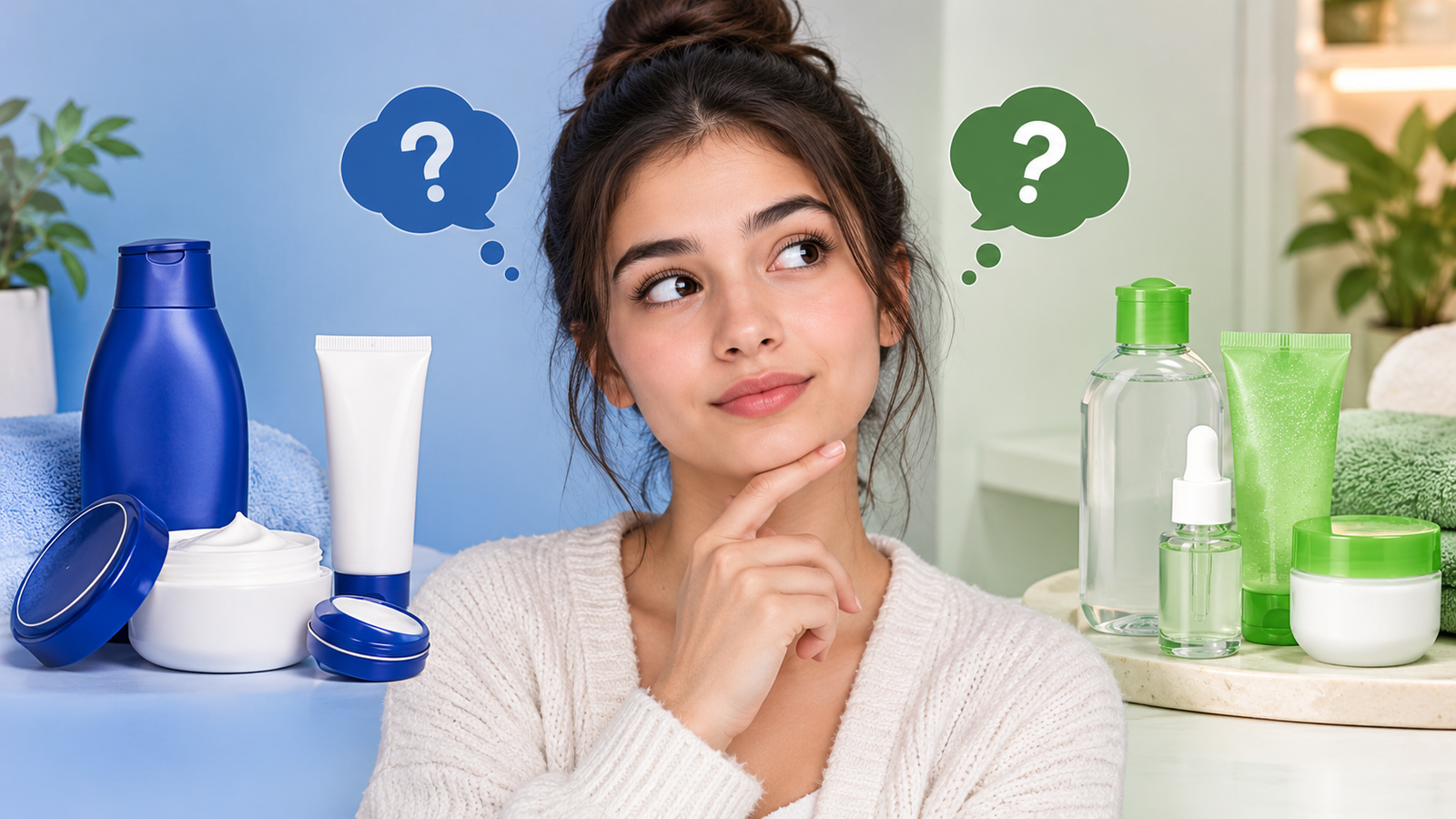
Starting a skincare routine can feel surprisingly complicated. Walk into a supermarket, pharmacy, beauty store, or online marketplace and you may encounter cleansers, moisturizers, exfoliants, serums, masks, sunscreens, micellar waters, eye products, anti-aging formulas, brightening treatments, and countless variations of each. For someone who is completely new to skincare, choosing the right brand can therefore seem almost as important as choosing the right product.
Two familiar names that frequently appear at the beginning of that search are Nivea and Garnier. Both brands have extensive product ranges, strong international recognition, and products designed for different skincare needs. Yet they approach skincare from somewhat different perspectives. Nivea is particularly associated with straightforward cleansing, moisturizing, body care, and everyday skin maintenance, while Garnier has developed a particularly visible presence in cleansing, micellar water, masks, serums, vitamin-focused products, and complexion-oriented skincare.
That naturally raises an important question: i’m a skincare beginner. is nivea a good starting brand compared to garnier?
For many beginners, Nivea can indeed be a sensible place to start, particularly when the goal is to establish a simple routine centered on cleansing, moisturizing, and protecting the skin barrier. Garnier can also be an excellent starting point, especially for someone interested in lightweight facial products, micellar cleansing, brightening ingredients, or a broader selection of targeted formulas.
The more useful question is not simply which brand is “better.” It is which brand makes it easier for a beginner to understand their skin, build a manageable routine, tolerate the products well, and make sensible decisions without buying far more than they actually need.
Quick Comparison: Nivea vs. Garnier for Beginners
| Category | Nivea | Garnier |
|---|---|---|
| Beginner friendliness | Very good for simple routines | Very good for targeted routines |
| Brand identity | Moisturizing, cleansing, body and everyday skincare | Cleansing, micellar products, masks, serums and targeted care |
| Product variety | Broad | Broad |
| Simple moisturizer options | Strong | Strong |
| Cleansing options | Strong | Particularly well known for micellar cleansing |
| Targeted skincare | Moderate to extensive depending on market | Extensive |
| Brightening-focused products | Available | Particularly prominent |
| Sensitive-skin suitability | Product-dependent | Product-dependent |
| Fragrance-free choices | Available in selected products | Available in selected products |
| Best beginner strategy | Keep the routine simple | Start simple and add targeted products gradually |
| Main beginner concern | Some formulas may feel rich or fragranced | Too many active-oriented choices can encourage overcomplication |
Biography Table: Nivea and Garnier at a Glance
| Brand | Nivea | Garnier |
|---|---|---|
| Brand category | Personal care and skincare | Beauty and skincare |
| Parent company | Beiersdorf | L’Oréal |
| International presence | Extensive | Extensive |
| Established brand history | More than a century | More than a century |
| Major skincare identity | Moisturizing and everyday skin care | Cleansing, skincare and targeted beauty care |
| Popular beginner products | Cleansers, creams, lotions and moisturizers | Micellar water, cleansers, moisturizers and masks |
| Typical beginner appeal | Familiar, uncomplicated everyday care | Accessible introduction to targeted skincare |
| Ideal starting philosophy | Basic and consistent | Basic first, targeted products later |
The Real Question: What Does a Beginner Actually Need?
Before comparing two brands, it helps to remove one of the biggest misconceptions about skincare: beginners do not need a complicated routine.
A strong beginner routine can be remarkably simple. In many cases, the foundation consists of three categories:
- A gentle cleanser.
- A moisturizer suited to the person’s skin.
- A broad-spectrum sunscreen for daytime use.
Everything beyond those basics should have a reason for being there.
This is particularly important because beginners often make the same mistake. They see several attractive products and assume that a complete skincare routine must include all of them immediately. A cleanser is followed by toner, serum, exfoliant, mask, eye cream, spot treatment, facial oil, and several other products. The result may be an expensive and confusing routine in which the user cannot determine what is actually helping.
When considering the question i’m a skincare beginner. is nivea a good starting brand compared to garnier?, simplicity should therefore be one of the most important criteria.
Nivea has a natural advantage here because much of its reputation has been built around familiar everyday skincare categories, particularly cleansing and moisturizing. Garnier can also work extremely well, but its broad assortment of targeted products can tempt beginners to move into specialized skincare before they understand their basic needs.
Understanding Nivea as a Beginner Brand
Nivea is one of the most recognizable skincare names in the world. Its identity has historically been associated with moisturization, skin comfort, cleansing, body care, and accessible everyday products.
For a beginner, that positioning can be useful.
Someone who has never established a routine may not need an aggressive treatment. They may simply need to wash the face appropriately, moisturize when necessary, and protect the skin during daytime exposure to ultraviolet radiation.
Nivea offers products across many of these basic categories.
Its broad catalog also means that beginners can create a routine without immediately moving into highly specialized formulas. A person can start with a basic cleanser and moisturizer and learn how their skin behaves before considering additional products.
However, Nivea is not a single formula. This distinction matters.
A brand can contain excellent products for one person and unsuitable products for another. Skin type, ingredient preferences, fragrance tolerance, climate, age, and individual concerns all influence whether a particular formula feels comfortable.
Therefore, saying that Nivea is good for beginners does not mean that every Nivea product is appropriate for every beginner.
Understanding Garnier as a Beginner Brand
Garnier occupies a somewhat different position in the beauty market. Its skincare portfolio includes cleansing products, micellar waters, moisturizers, masks, serums, and products designed around particular cosmetic or skincare concerns.
One of Garnier’s most recognizable contributions to modern accessible skincare is the popularity of micellar cleansing products. These can be particularly convenient for people who want a quick cleansing step or need to remove makeup and surface impurities.
Garnier also places considerable emphasis on ingredients and targeted benefits. Depending on the product range available in a particular country, consumers may encounter products associated with vitamin C, hyaluronic acid, niacinamide, exfoliating acids, charcoal, or other recognizable skincare ingredients.
This can be valuable for beginners who want to learn about modern skincare.
But it also introduces a potential problem.
A beginner who sees a product advertised for brightening, smoothing, hydration, pores, blemishes, or radiance may feel pressure to address every concern simultaneously. Skincare then becomes unnecessarily complicated.
For that reason, Garnier is often best approached progressively: establish the basics first, then introduce one targeted product at a time if there is a genuine reason to do so.
I’m a Skincare Beginner. Is Nivea a Good Starting Brand Compared to Garnier?
The short answer is yes, Nivea can be a very good starting brand, but that does not automatically make it better than Garnier.
The strongest beginner choice depends on what you want from your first routine.
If your priority is uncomplicated moisturization and everyday skincare, Nivea may feel more intuitive.
If you are especially interested in micellar cleansing, lightweight facial products, brightening-oriented skincare, or learning about specific ingredients, Garnier may be more appealing.
The important principle is that the product matters more than the logo on the packaging.
A well-tolerated, appropriate cleanser from one brand is more useful than an unsuitable cleanser from a supposedly superior brand. The same is true of moisturizers, sunscreens, and targeted treatments.
Beginners should evaluate individual formulas rather than treating a brand as universally suitable.
Nivea’s Biggest Advantage: Simplicity
One of Nivea’s strongest qualities for newcomers is its familiarity.
A beginner often wants to know:
- What should I wash my face with?
- What should I apply afterward?
- Do I need moisturizer?
- What should I use during the day?
- How many products are actually necessary?
Nivea’s everyday-care identity makes these questions easier to approach.
A simple Nivea-centered routine could involve a facial cleanser, moisturizer, and sunscreen. Depending on skin type and personal preferences, the cleanser and moisturizer could be adjusted over time.
This is valuable because consistency usually matters more than collecting products.
A beginner who follows a simple routine consistently is often in a better position than someone who owns ten products but changes them every few days.
Garnier’s Biggest Advantage: Targeted Choices
Garnier’s strength lies in its broad selection of products that address particular skincare goals.
Someone interested in hydration can explore hydrating products. Someone concerned about dull-looking skin may find brightening-oriented options. Someone interested in cleansing can consider different micellar or facial-cleansing products.
This makes Garnier attractive to beginners who want to learn about ingredients and specific skincare functions.
The potential downside is choice overload.
When a person sees a dozen products promising different benefits, it can become difficult to determine which ones are actually necessary.
A sensible beginner should resist the urge to purchase several active products simultaneously.
Skin Type Matters More Than Brand Loyalty
One of the most important lessons in beginner skincare is that skin type should influence product selection.
The traditional categories are:
- Normal
- Dry
- Oily
- Combination
- Sensitive
These categories are useful, but real skin can be more complicated.
A person can have oily areas and dehydrated areas at the same time. Someone can have generally normal skin but become sensitive to a particular ingredient. A person living in a hot, humid environment may prefer a different moisturizer texture than someone living in a cold, dry climate.
This means the question i’m a skincare beginner. is nivea a good starting brand compared to garnier? cannot be answered responsibly without considering the individual’s skin.
For Dry Skin
Dry skin often benefits from products that support moisture retention and reduce the uncomfortable feeling of tightness.
A richer moisturizer may be preferable, particularly at night.
Nivea’s long-standing reputation for moisturizing products can make it appealing to people with dry or normal-to-dry skin. However, richer textures are not automatically better. A product should feel comfortable rather than excessively heavy.
Garnier also offers moisturizing products, including formulas designed around hydration.
For Oily Skin
Oily skin can create a temptation to use harsh products in an attempt to remove every trace of oil.
That approach can backfire by producing irritation and discomfort.
Beginners with oily skin should look for effective but non-aggressive cleansing and a moisturizer with a texture they can comfortably use.
Garnier may appeal to some oily-skin users because of its range of lightweight and targeted facial products. Nivea also offers lighter facial-care options, depending on the specific market and product line.
For Combination Skin
Combination skin can be particularly confusing.
The forehead, nose, and chin may become oily while the cheeks feel normal or dry.
Instead of buying multiple specialized products immediately, beginners should usually start with a balanced cleanser and a lightweight-to-moderate moisturizer. The routine can then be adjusted based on how different areas respond.
For Sensitive Skin
Sensitivity requires additional caution.
A beginner with reactive skin should not assume that a product is suitable simply because it is marketed as gentle or because thousands of people use it successfully.
Ingredient lists matter.
Fragrance can be a concern for some sensitive individuals, while certain preservatives, botanical ingredients, or active ingredients can also cause problems in susceptible users.
Both Nivea and Garnier have products that differ considerably from one another, so sensitive-skin users should evaluate individual formulas rather than making a blanket judgment about either brand.
Fragrance: An Important Beginner Consideration
Fragrance is one of the most misunderstood subjects in mainstream skincare.
Fragrance does not automatically make a product bad. Many people use fragranced skincare without difficulty.
However, people with sensitive or reactive skin may prefer fragrance-free products because unnecessary fragrance can be a source of irritation for some individuals.
This means that a beginner should learn to inspect product labels rather than assuming that an entire brand is either “safe” or “unsafe.”
Nivea contains both fragranced and differently formulated products across its portfolio. Garnier is similarly diverse.
The right approach is simple: identify the exact product, examine its ingredients, and consider how your skin has reacted to similar products previously.
Cleansing: Where Garnier Often Stands Out
Garnier has developed a particularly strong association with micellar cleansing.
Micellar water can be convenient for removing makeup and surface impurities, although its role in a routine depends on how it is being used and what the individual prefers.
For some people, micellar water can function as part of a first cleansing step. Others may prefer a conventional facial cleanser.
The most important point is that cleansing should not become an exercise in aggressively stripping the skin.
A beginner does not need a cleanser that leaves the face feeling extremely tight or squeaky.
That sensation is not necessarily evidence of superior cleanliness.
Moisturizing: Where Nivea Has a Natural Beginner Appeal
Moisturization is one of the easiest places to understand Nivea’s appeal.
A moisturizer helps support the skin’s protective barrier and reduce excessive water loss from the outer layers of the skin.
Different textures are useful for different skin types. Creams tend to feel richer, while gels and lightweight lotions can feel more comfortable for some oily or combination-skin users.
Nivea has extensive experience in this category, making it a natural candidate for a beginner’s first moisturizer.
But once again, the exact formula matters.
A moisturizer that feels excellent on dry skin may feel excessively heavy on oily skin. A fragranced cream may be comfortable for one user but undesirable for another.
Sunscreen Should Not Be an Afterthought
One area where beginner skincare often goes wrong is the disproportionate attention given to cleansers and serums while sunscreen receives little consideration.
Daily ultraviolet protection is an important part of a sensible daytime skincare routine.
A beginner does not need an elaborate anti-aging program to begin protecting their skin. Regular use of an appropriate broad-spectrum sunscreen can be a more meaningful foundational habit.
Both Nivea and Garnier have sun-care offerings in various markets, although exact formulations and availability vary by country.
When choosing sunscreen, look beyond the brand. Consider broad-spectrum protection, SPF level, texture, application amount, reapplication practicality, and whether the product works comfortably with your skin.
If a sunscreen is unpleasant to wear, people may be less likely to use enough of it consistently.
The Beginner Mistake: Buying Too Many Products
The skincare industry can make complexity look sophisticated.
A shelf filled with bottles can appear more serious than a simple three-step routine.
But skincare effectiveness does not increase merely because the number of products increases.
Beginners should be particularly careful with exfoliating acids, retinoids, strong vitamin-based formulas, concentrated treatments, and multiple active ingredients.
Introducing several new products at once makes it difficult to identify the cause if irritation occurs.
A better approach is gradual introduction.
Start with a cleanser, moisturizer, and daytime sunscreen.
Give your routine time.
Once you understand how your skin responds, consider whether you actually need another product.
A Simple Nivea Beginner Routine
For someone whose primary goal is basic skincare, a simple routine can be structured around three steps.
Morning
Begin with gentle cleansing if necessary. Some people may prefer simply rinsing their face depending on their skin type and overnight oil production.
Apply moisturizer if needed.
Finish with sunscreen.
Evening
Cleanse the skin to remove accumulated products, dirt, sweat, and sunscreen.
Apply moisturizer.
That is enough to establish a foundation.
The purpose of the first month is not to transform your skin overnight. It is to build consistency and understand how your skin behaves.
A Simple Garnier Beginner Routine
A Garnier-based routine can follow essentially the same principle.
Morning:
Cleanse gently.
Moisturize.
Apply sunscreen.
Evening:
Cleanse.
Moisturize.
If micellar water is used for makeup or sunscreen removal, it can be incorporated according to the product’s directions and the user’s preferred cleansing approach.
The key is that choosing Garnier does not require using every specialized product in the range.
Which Brand Is Better for Learning Skincare?
This is where the comparison becomes particularly interesting.
Nivea can teach a beginner the fundamentals of moisturization, cleansing, and routine consistency.
Garnier can teach a beginner more about targeted skincare and recognizable active ingredients.
Neither educational path is inherently superior.
A person who begins with Nivea may later explore Garnier products. Someone who begins with Garnier may eventually discover that a simpler Nivea routine better suits their skin.
Skincare is not a competition between brands.
It is a process of learning what works for an individual.
Value for Money and Accessibility
For beginners, price matters.
A routine that is financially comfortable is easier to maintain.
Both Nivea and Garnier operate in accessible segments of the beauty market, although prices vary significantly according to country, retailer, product type, promotions, and formulation.
The cheapest product is not necessarily the best value.
Value should be considered in terms of:
- Price per use
- Product size
- How frequently it must be replaced
- Whether the formula suits your skin
- Whether you actually need the product
- Whether you are likely to use it consistently
A discounted serum that irritates your skin is not a bargain.
A modestly priced moisturizer that you use every day may represent much better value.
Nivea vs. Garnier for a First Cleanser
For a beginner cleanser, the most important characteristics are not glamorous marketing claims.
Look for a formula that cleans effectively without leaving persistent tightness, burning, or discomfort.
Nivea offers conventional cleansing choices that can fit simple routines.
Garnier offers traditional facial cleansing options as well as micellar products.
If you wear makeup or simply enjoy micellar cleansing, Garnier may have an advantage in terms of familiarity and choice.
If you want a straightforward everyday cleansing routine, Nivea can be equally reasonable.
Nivea vs. Garnier for a First Moisturizer
Nivea has a particularly strong reputation in moisturizing, making it a natural contender for a beginner’s first moisturizer.
Garnier also provides hydration-focused options, often with more explicit emphasis on particular ingredients or benefits.
The decision should ultimately come down to texture, ingredients, skin type, tolerance, climate, and personal preference.
Someone with dry skin may enjoy a richer cream.
Someone with oily skin may prefer a lighter lotion or gel-like texture.
Someone with sensitive skin may prioritize a minimal formula.
Nivea vs. Garnier for Brightening
Brightening is one of the areas where Garnier can be especially attractive.
The term “brightening” generally refers to improving the appearance of dullness or uneven-looking skin rather than literally changing someone’s natural skin color.
Products marketed around vitamin C and other brightening ingredients can appeal to beginners who want a more targeted routine.
However, beginners should understand that brightening products are not magic solutions.
Consistent sun protection remains important, especially when concerns involve uneven pigmentation.
Nivea vs. Garnier for Acne-Prone Skin
Neither brand should be treated as an automatic solution for acne.
Acne is a skin condition with different causes and levels of severity.
A beginner with occasional blemishes may be interested in appropriately formulated skincare, but persistent, painful, widespread, or scarring acne may require professional evaluation.
The wrong strategy is to attack acne aggressively with multiple drying products.
The better strategy is to maintain a gentle foundation and introduce appropriate targeted care carefully.
What Beginners Should Look for on the Label
Learning to read skincare labels is more useful than memorizing brand reputations.
Pay attention to:
- Product purpose
- Skin-type recommendations
- Ingredient list
- Fragrance
- Active ingredients
- Texture
- Instructions
- Expiration or period-after-opening information
- Packaging and storage requirements
Marketing language can be persuasive, but the formula determines how the product actually behaves.
Patch Testing and Gradual Introduction
When trying a new skincare product, especially a leave-on product, introducing it gradually can help identify potential problems.
If you have a history of significant reactions, consult an appropriate healthcare professional or dermatologist for individualized guidance.
Avoid applying multiple new products simultaneously.
If something causes persistent burning, swelling, severe redness, or another concerning reaction, stop using it and seek appropriate medical advice.
Why Consistency Beats Brand Hopping
One of the most damaging beginner habits is changing products constantly.
Someone tries a moisturizer for three days, decides it is not revolutionary, purchases another one, adds a serum, then changes the cleanser.
This makes it almost impossible to determine what works.
A more intelligent approach is controlled experimentation.
Change one significant variable at a time.
Observe your skin.
Keep what works.
Remove what does not.
This method turns skincare from impulsive shopping into a practical learning process.
I’m a Skincare Beginner. Is Nivea a Good Starting Brand Compared to Garnier? A Practical Verdict
If the question is whether Nivea is a legitimate and sensible starting point for a skincare beginner, the answer is yes.
Nivea’s strengths are particularly apparent for people who want familiar, accessible products centered on cleansing, moisturizing, and everyday care.
Garnier is equally credible as a starting point, particularly for consumers attracted to micellar cleansing, targeted facial products, and ingredient-focused skincare.
The better choice depends on what kind of beginner you are.
Choose Nivea if you want:
- A simple introduction to everyday skincare
- Strong emphasis on moisturization
- Familiar basic-care products
- A straightforward routine
- A gradual approach to skincare
Consider Garnier if you want:
- Micellar cleansing options
- More targeted skincare choices
- Ingredient-oriented products
- Brightening-focused options
- A broader selection of specialized facial products
Neither decision needs to be permanent.
Your first skincare brand is not a lifelong commitment.
Common Questions Beginners Ask
Is Nivea good for someone who has never used skincare?
Yes. Nivea can be a practical starting point because its range includes basic skincare categories such as cleansing and moisturization. The important consideration is choosing an individual product appropriate for your skin rather than assuming every Nivea formula will suit everyone.
Is Garnier better than Nivea for beginners?
Not universally. Garnier may be more attractive to beginners interested in micellar water, targeted treatments, and ingredient-focused skincare, while Nivea may be easier for someone seeking simple everyday moisturization and cleansing.
Can I use Nivea every day?
Many Nivea products are designed for regular use, but the appropriate frequency depends on the individual product and your skin. Follow the product directions and pay attention to how your skin responds.
Is Garnier suitable for sensitive skin?
Some Garnier products may be suitable for sensitive skin, but the brand as a whole cannot be classified as universally suitable for sensitive skin. Examine the specific formula and consider fragrance and other ingredients that may be relevant to your individual sensitivity.
Should a beginner use a serum?
A serum is optional. Beginners generally benefit more from establishing cleansing, moisturization, and daytime sun protection before adding specialized treatments.
Do I need both Nivea and Garnier?
No. There is no requirement to use products from both brands. You can build an effective routine entirely from one brand, mix brands, or use products from several companies. Compatibility and suitability matter more than brand consistency.
Is Nivea good for oily skin?
Some Nivea products can work well for oily skin, particularly lighter facial formulations, but richer creams may feel uncomfortable for certain oily-skin users. Always evaluate the specific product’s texture and formulation.
Is Garnier good for dry skin?
Yes, some Garnier products are designed around hydration and can work well for dry skin. However, product selection should consider how rich or lightweight the formula is and whether it provides the level of comfort your skin requires.
Which is cheaper, Nivea or Garnier?
Neither brand is consistently cheaper across every market and product category. Prices vary by country, retailer, product size, and promotions. Comparing cost per milliliter or cost per use is more meaningful than comparing brand reputation alone.
Can I switch from Nivea to Garnier?
Absolutely. Skincare brands do not need to be permanent choices. If a product does not suit your skin, switching to another formula can be reasonable.
Can I use a Nivea moisturizer with a Garnier cleanser?
Yes. There is generally no need for every skincare product to come from the same brand. A cleanser from one brand and moisturizer from another can work perfectly well together.
How many skincare products should a beginner buy?
A beginner can start with three basic categories: cleanser, moisturizer, and sunscreen. Additional products should be introduced only when there is a clear reason to use them.
A Beginner’s Decision Framework
When choosing between Nivea and Garnier, ask yourself five questions.
First, what is my skin type?
Second, what is my primary goal: basic maintenance, hydration, cleansing, brightness, blemishes, or something else?
Third, do I prefer a minimal routine or a more targeted routine?
Fourth, does the specific product contain ingredients I know my skin tolerates?
Fifth, will I realistically use this product consistently?
These questions are more valuable than simply asking which logo is better.
The Importance of Expectations
Skincare rarely delivers dramatic results overnight.
Healthy-looking skin is usually the result of repeated habits rather than a single miracle product.
A cleanser cannot solve every concern.
A moisturizer cannot replace sunscreen.
A serum cannot compensate for an unnecessarily harsh routine.
And an expensive product is not automatically more effective than an affordable one.
Beginners who understand this early are less likely to become frustrated by marketing claims and more likely to develop sustainable routines.
Building a Routine That Can Evolve
Your first routine should be a starting framework, not a permanent prescription.
After establishing the basics, you may discover that your skin becomes oilier in summer, drier during colder weather, or more sensitive when exposed to particular products.
Your routine can change accordingly.
This is another reason not to buy an entire skincare collection at once.
Start small.
Observe.
Adjust.
Learn.
Over time, you will become better at recognizing the difference between hydration and oiliness, irritation and temporary adjustment, cleansing and over-cleansing, and genuine skincare needs versus attractive marketing.
A More Intelligent Way to Choose Between Nivea and Garnier
The most useful way to answer i’m a skincare beginner. is nivea a good starting brand compared to garnier? is to move away from the idea of a single winner.
Nivea is an excellent candidate for a simple, approachable first routine.
Garnier is an excellent candidate for someone who wants accessible cleansing and more targeted facial-care options.
For a complete beginner, simplicity may give Nivea a slight practical advantage because it is easier to construct a straightforward routine around fundamental skincare categories.
For a beginner who is already interested in ingredients and specific concerns, Garnier may offer a more stimulating starting point.
Neither approach is wrong.
The real objective is to establish a routine that is gentle enough to tolerate, simple enough to maintain, affordable enough to continue, and appropriate enough for your individual skin.
When to Move Beyond Basic Skincare
There comes a point when a beginner may need more specialized guidance.
Persistent acne, significant pigmentation, recurring irritation, severe dryness, unexplained rashes, painful lesions, or sudden changes in the skin should not automatically be treated by purchasing more cosmetic products.
A dermatologist or qualified healthcare professional can help identify whether an underlying condition is involved and recommend an appropriate treatment strategy.
Cosmetic skincare has an important role, but it has limits.
Recognizing those limits is part of becoming a knowledgeable skincare consumer.
The Beginner’s Long-Term Perspective
The most successful skincare routine is rarely the one with the most impressive shelf.
It is the routine that fits real life.
If you travel frequently, products need to be portable.
If you dislike heavy textures, a rich cream may remain untouched.
If your schedule is busy, a complicated seven-step routine may quickly become unsustainable.
If your skin is sensitive, a minimal routine may be far more valuable than an elaborate collection of active ingredients.
That is why the answer to i’m a skincare beginner. is nivea a good starting brand compared to garnier? ultimately comes down to compatibility rather than popularity.
Nivea can provide a dependable introduction to foundational skincare.
Garnier can provide an accessible pathway into targeted skincare.
Both can be useful.
Neither needs to be treated as an absolute winner.
The Best Place to Begin
For someone starting from zero, the smartest approach is deliberately unexciting: choose one suitable cleanser, one moisturizer, and one reliable sunscreen. Use them consistently, introduce new products slowly, and pay attention to what your skin is telling you.
If Nivea offers the textures and formulations you enjoy, it can be an excellent starting point. If Garnier’s cleansing or targeted products better match your needs, it can serve the same purpose.
The ultimate measure of a good beginner brand is not how many products it sells or how recognizable its packaging is. It is whether it helps you develop sensible skincare habits without unnecessary complexity.
That is the foundation on which a genuinely effective skincare routine can be built.
