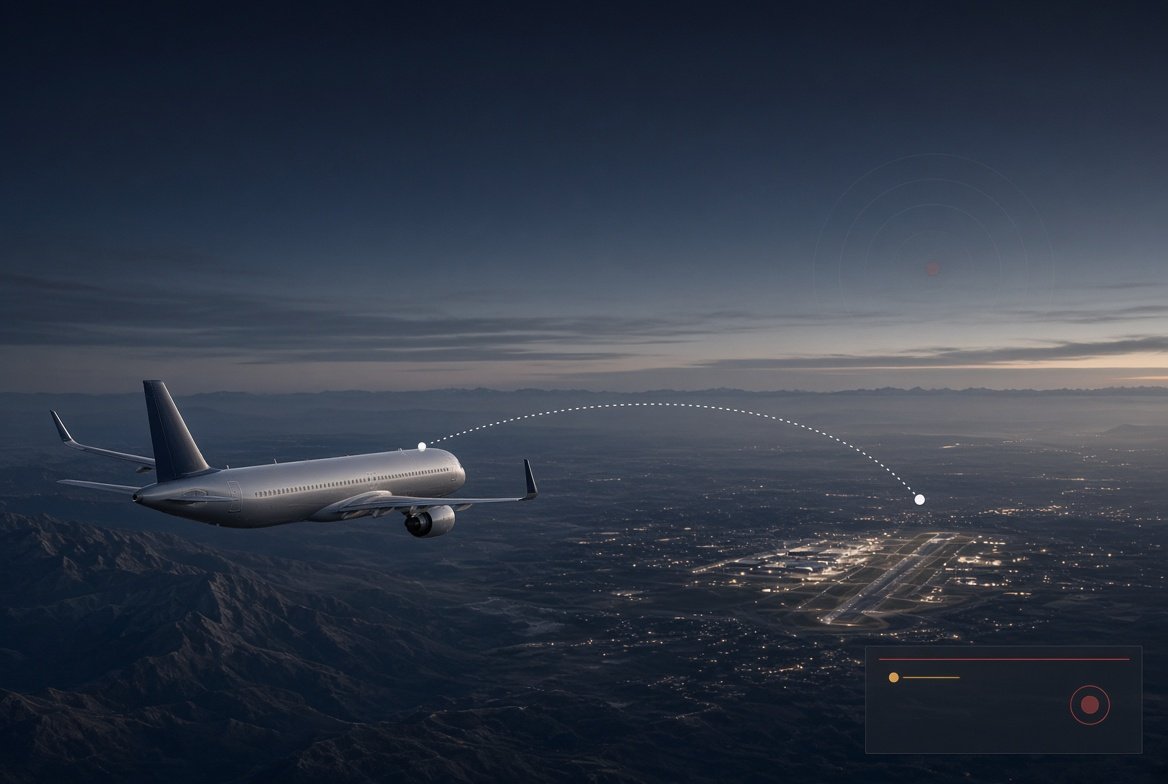
The phrase easyJet emergency flight U22058 has attracted considerable attention because the flight number has appeared in several aviation incident reports involving different aircraft and different circumstances. For passengers searching for what happened, the most important point is that U22058 is not the name of one particular aircraft. It is a scheduled flight number used for the easyJet service connecting Heraklion in Crete with Manchester in the United Kingdom.
That distinction matters.
An aircraft operating under the U22058 number can change from one day to another, and so can the crew. Consequently, separate incidents associated with the same flight number should not automatically be treated as one continuing mechanical problem.
The route itself is a regular international service between Greece and the United Kingdom. Current schedule information shows U22058 operating from Heraklion International Airport to Manchester Airport, with Airbus A320-family aircraft used on the route. Recent schedules list the service arriving at Manchester Terminal 2.
The emergency events associated with easyJet emergency flight U22058 include a May 12, 2026 diversion to Milan Malpensa after the first officer required medical assistance, as well as earlier incidents in 2025 involving a passenger medical emergency and a separate hydraulic problem. The May 2026 event is particularly important because it demonstrates how an apparently routine holiday flight can be diverted even when the aircraft itself is not experiencing a catastrophic failure.
This article explains the flight’s identity, route, aircraft, documented emergencies, the meaning of emergency transponder codes, how diversion decisions are made, what passengers can expect after an unscheduled landing, and why multiple incidents carrying the same flight number do not necessarily indicate a common underlying fault.
easyJet Emergency Flight U22058 at a Glance
| Detail | Information |
|---|---|
| Flight number | U22058 |
| Airline | easyJet |
| Callsign / flight designation | EZY2058 |
| Normal route | Heraklion (HER) to Manchester (MAN) |
| Origin country | Greece |
| Destination country | United Kingdom |
| Aircraft family | Airbus A320 family |
| Typical distance | Approximately 2,900 km |
| Typical flight time | Around four hours |
| Major documented 2026 incident | May 12, 2026 |
| 2026 diversion airport | Milan Malpensa |
| 2026 aircraft | Airbus A321-200N |
| 2026 aircraft registration | G-UZME |
| 2026 reported reason | First officer required medical assistance |
| Outcome | Safe landing and subsequent continuation of journey |
The May 12, 2026 incident was classified by aviation incident reporting sources as an incident rather than an accident. The aircraft landed safely at Milan Malpensa, passengers were provided with accommodation and meals, and the aircraft subsequently continued to Manchester after remaining on the ground for approximately 12 hours.
What Is easyJet Flight U22058?
easyJet flight U22058, also written as U2 2058 or EZY2058, is a scheduled passenger service between Heraklion and Manchester.
Heraklion is the principal airport serving Crete, one of Greece’s most important tourist destinations. Manchester, meanwhile, is a major airport serving northern England. The route is therefore particularly relevant to seasonal leisure travel between the United Kingdom and Greece.
Flight-number records show U22058 operating on multiple days of the week, with schedules varying according to the season. Current September 2026 records list Airbus A320-family aircraft on the route and show Manchester as the destination.
This is important when researching easyJet emergency flight U22058 because the flight number should not be confused with an aircraft registration.
A registration such as G-UZME identifies a particular aircraft. U22058 identifies the scheduled service.
One day, U22058 might be operated by an Airbus A321neo. On another day, an Airbus A320 or A320neo may operate the same flight. Recent flight-history data demonstrates that several different aircraft registrations have operated U22058.
That operational flexibility is normal in commercial aviation.
The May 12, 2026 U22058 Emergency
The most recent major emergency associated with easyJet emergency flight U22058 documented in the available aviation incident reporting occurred on May 12, 2026.
On that day, an easyJet Airbus A321-200N, registration G-UZME, was flying from Heraklion to Manchester. The aircraft was cruising at approximately Flight Level 340, or around 34,000 feet, when the captain decided to divert toward Milan Malpensa because the first officer required medical assistance.
The aircraft was reported to be approximately 80 nautical miles east-northeast of Milan when the decision to divert was made.
This was not reported as an engine failure, structural failure, fire, or loss of control.
Instead, the issue concerned a member of the operating flight crew.
That distinction is significant because aviation emergencies do not have to involve a problem with the aircraft itself. A medical problem affecting a pilot can be sufficient reason to change the flight plan.
Why a Pilot Medical Emergency Can Require a Diversion
Commercial aircraft are designed to be operated by a two-person flight crew in the cockpit. The captain and first officer have different responsibilities, but both are essential parts of the flight-deck operating system.
If one pilot becomes medically unable to perform normal duties, the remaining pilot may still be capable of flying the aircraft. However, continuing a long international flight may not be considered the most appropriate course of action.
The captain therefore has to consider several factors.
These include the condition of the other pilot, the aircraft’s location, fuel remaining, weather, available airports, airport operating conditions, medical support, and the time required to reach the destination.
In the case of U22058 on May 12, 2026, Milan Malpensa was selected as the diversion airport.
The decision allowed medical personnel to meet the aircraft on arrival and removed the need to continue a long flight while one of the flight-deck crew members required assistance.
The Aircraft Involved in the 2026 Incident
The aircraft involved in the May 12 incident was registered G-UZME.
It was an Airbus A321-200N, commonly described as an A321neo.
The A321neo belongs to the Airbus A320neo family and is a narrow-body aircraft designed for short- and medium-haul routes. It is widely used by European airlines for high-volume regional and international services.
G-UZME was therefore not an unusual type of aircraft for an easyJet route such as Heraklion to Manchester.
The incident reporting record identifies the aircraft as an A321-200N and states that it landed safely at Milan Malpensa’s runway 35L approximately 25 minutes after the diversion decision.
The aircraft was then met by medical services.
What Happened After the Landing in Milan?
Once U22058 landed at Milan Malpensa, the immediate priority was no longer the flight itself but the medical situation.
According to the incident report, the passengers were provided with hotels and meals. The aircraft remained in Milan for roughly 12 hours before continuing toward Manchester.
For passengers, an unexpected diversion can be disruptive even when the landing is completely safe.
A journey that was supposed to finish in Manchester instead temporarily ended in Italy.
Passengers may suddenly need to consider:
- Where they will stay
- When the replacement departure will occur
- What happens to checked baggage
- Whether onward transportation will be provided
- Whether meals are supplied
- Whether they need to contact people waiting at Manchester
- Whether additional travel arrangements need to be changed
Airlines therefore have procedures designed to manage the practical consequences of diversions as well as the aviation emergency itself.
In the case of U22058’s May 2026 diversion, reported passenger care included accommodation and meals before the journey continued.
Why Milan Malpensa Was a Logical Diversion Airport
A diversion airport is not necessarily the nearest airport visible on a map.
The crew has to consider whether the airport is suitable for the aircraft, whether the runway is appropriate, whether weather conditions are acceptable, whether air traffic control can accommodate the aircraft, and whether the airport has the emergency and medical resources required.
Milan Malpensa is a major international airport with substantial infrastructure.
For an aircraft flying near northern Italy, it can therefore be an appropriate destination when an emergency requires the aircraft to land sooner than originally planned.
The location of U22058 near Milan made Malpensa a practical option in the May 2026 incident.
Was the U22058 Aircraft in Danger?
Available reporting does not describe the May 12, 2026 U22058 event as an aircraft-control emergency.
The reported reason for the diversion was that the first officer needed medical assistance. The aircraft landed safely, and the captain performed the landing. Medical services met the aircraft at Milan Malpensa.
This distinction is worth emphasizing because online discussions about aviation incidents can sometimes use the word “emergency” to suggest a catastrophic event.
In aviation terminology, an emergency means that the crew needs assistance or priority because the circumstances require it. It does not automatically mean that the aircraft is about to crash.
A medical diversion can therefore be an emergency while the aircraft remains fully controllable and the landing proceeds normally.
The Earlier 2025 U22058 Emergency Over France
The history of easyJet emergency flight U22058 is more complicated because the same flight number was associated with another emergency on July 1, 2025.
On that occasion, U22058 was flying from Heraklion to Manchester when the crew declared an emergency over France.
The aircraft was an Airbus A320neo registered G-UZEF.
The aircraft was reported to have been cruising at approximately 38,000 feet when the emergency occurred. Aviation reporting stated that a passenger had become seriously ill and the crew diverted to Paris Charles de Gaulle Airport.
The aircraft subsequently landed safely at Paris CDG.
The July 2025 Timeline
Available reporting gives the following general sequence:
| Event | Reported detail |
|---|---|
| Departure | Heraklion, Greece |
| Destination | Manchester, United Kingdom |
| Aircraft | Airbus A320neo |
| Registration | G-UZEF |
| Cruise altitude | Approximately 38,000 feet |
| Emergency | Passenger medical situation |
| Emergency code | Squawk 7700 |
| Diversion | Paris Charles de Gaulle |
| Landing runway | 26R |
| Outcome | Safe landing |
AIRLIVE reported on July 1, 2025 that U22058 was diverting to Paris after declaring an emergency over France. Its update subsequently identified a medical emergency onboard as the reason for the diversion.
Understanding Squawk 7700
One of the most frequently searched phrases connected with easyJet emergency flight U22058 is “Squawk 7700.”
Squawk 7700 is the internationally recognized transponder code used to indicate a general emergency.
An aircraft’s transponder communicates information to air traffic control. Under ordinary circumstances, aircraft operate with assigned transponder codes.
Certain codes have special meanings.
| Code | General meaning |
|---|---|
| 7700 | General emergency |
| 7600 | Radio communication failure |
| 7500 | Unlawful interference |
When pilots select 7700, controllers are alerted that the aircraft needs emergency attention.
The code does not itself explain the problem.
It could represent a medical situation, technical malfunction, severe weather problem, fuel concern, or another event requiring priority handling.
That is why the words “Squawk 7700” should not be interpreted as a precise description of what happened.
For U22058, the surrounding circumstances established the reason for the emergency.
The August 2025 U22058 Incident
The flight number appeared again in emergency reporting on August 6, 2025.
This time, another aircraft was operating the Heraklion-to-Manchester service.
The reported aircraft was G-EZTJ, an Airbus A320-200.
The problem was different from the July medical emergency.
Reports identified a hydraulic leak as the reason for the diversion. The aircraft diverted to Paris Charles de Gaulle, where it could be inspected and repaired.
This created an unusual sequence:
- July 2025: passenger medical emergency
- August 2025: hydraulic problem
- May 2026: first officer required medical assistance
All three events involved U22058, but they did not involve the same aircraft or the same cause.
Why the Same Flight Number Can Appear in Different Emergencies
This is perhaps the most important fact for understanding easyJet emergency flight U22058.
A flight number is part of an airline’s timetable.
It is not permanently assigned to one physical airplane.
Airlines operate fleets of aircraft and constantly adjust aircraft assignments according to scheduling, maintenance, crew availability, operational requirements, and network planning.
Therefore:
U22058 on one date may use an A320.
U22058 on another date may use an A320neo.
U22058 on another date may use an A321neo.
Flight-history records demonstrate this changing aircraft assignment. For example, recent U22058 operations have involved multiple aircraft registrations.
The same principle applies to crews.
The pilots operating U22058 on one date are not necessarily the same pilots operating it weeks or months later.
Therefore, three separate incidents connected to the same flight number should be investigated individually rather than treated as one continuous event.
Was There a Common Mechanical Problem?
There is no evidence in the incident reports cited here establishing one common mechanical defect linking the May 2026 medical diversion with the 2025 incidents.
The May 2026 event concerned the first officer requiring medical assistance.
The July 2025 event involved a passenger medical emergency.
The August 2025 event was reported as a hydraulic leak involving a different aircraft.
Those are materially different circumstances.
It would therefore be misleading to combine them into one mechanical narrative.
How Airline Crews Handle an In-Flight Emergency
Commercial pilots are trained to manage abnormal and emergency situations through established procedures.
The first step is identifying the nature of the problem.
The crew then determines what action is required.
Depending on the situation, this could mean:
- Continuing to the original destination
- Changing altitude
- Requesting priority handling
- Diverting to another airport
- Declaring an emergency
- Coordinating with medical or airport services
- Preparing the cabin for an expedited landing
The captain has overall command responsibility for the aircraft.
In the May 2026 U22058 event, the captain decided to divert because the first officer required medical assistance. The aircraft then landed safely at Milan Malpensa.
Why Crews May Divert Even When the Aircraft Is Flying Normally
Passengers sometimes wonder why a plane cannot simply continue if the aircraft itself appears to be operating normally.
The answer is that aviation safety is based on managing risk before it becomes critical.
A pilot becoming medically incapacitated changes the operating environment.
The remaining pilot has to operate the aircraft while potentially managing additional workload. Medical support may also be required.
A diversion can therefore be a preventative safety decision.
Landing earlier gives the affected crew member access to professional medical care and restores the flight to a normal two-pilot operating environment once a replacement crew or other operational arrangement is available.
The Importance of Medical Support at Airports
Airports used for international diversions generally have access to emergency services.
When an aircraft advises air traffic control that a medical situation exists, airport responders can be prepared before landing.
That preparation can include:
- Ambulance crews
- Airport medical teams
- Ground staff
- Fire and rescue personnel where required
- Gate or stand coordination
- Passenger assistance
In the May 2026 U22058 case, medical services met the aircraft at Milan Malpensa.
This illustrates why diversion decisions are not based solely on geographical distance.
The availability of appropriate assistance can be just as important.
What Passengers May Experience During a Diversion
From a passenger’s perspective, an emergency diversion can be confusing.
The aircraft may suddenly change direction.
The captain may make an announcement.
Cabin crew may become more active.
The landing may occur at an airport that was never part of the original itinerary.
None of these developments necessarily mean the aircraft is in immediate danger.
Pilots and cabin crew are trained to communicate information while keeping passengers calm and preparing them for changes.
Once the aircraft reaches the ground, the situation becomes more practical.
Passengers may be asked to remain onboard temporarily while airport services or medical personnel attend to the situation.
They may later disembark and wait for further transportation arrangements.
The experience can be frustrating, but a safe diversion is an established part of commercial aviation operations.
What Happened to U22058 Passengers After the 2026 Diversion?
According to incident reporting, passengers affected by the May 12, 2026 diversion were provided with hotels and meals while the aircraft remained in Milan. The flight was rescheduled for the following morning and the aircraft later continued to Manchester.
This is an important part of the story because the emergency itself is only one stage of an irregular operation.
An airline must also manage passengers after the aircraft reaches the ground.
That can involve accommodation, food, rebooking, baggage, ground transportation, and communication.
Passenger Rights After an Emergency Diversion
Passenger rights depend on the circumstances of the disruption, the origin and destination, the airline, and the applicable legal framework.
A technical problem, weather event, medical emergency, air-traffic restriction, and crew illness can be treated differently under passenger-rights rules.
Passengers should therefore avoid assuming that every emergency automatically produces a fixed cash compensation payment.
A passenger who experienced a U22058 diversion should keep:
- Boarding passes
- Booking confirmation
- Delay or diversion notifications
- Receipts for necessary expenses
- Hotel documentation
- Meal receipts
- Records of replacement transportation
The exact legal entitlement should be assessed against the rules applicable to that particular journey and the reason for the disruption.
Does an Emergency Diversion Mean the Flight Was Unsafe?
Not necessarily.
An emergency diversion generally means that the crew determined that landing at another airport was preferable to continuing under the circumstances.
In fact, diversion is itself one of the safety tools available to pilots.
For U22058 in May 2026, the aircraft landed safely at Milan Malpensa after the first officer required medical assistance.
For the July 2025 event, the aircraft landed safely at Paris Charles de Gaulle after a passenger became seriously ill.
For the August 2025 hydraulic incident, the aircraft also diverted safely to Paris.
These outcomes demonstrate the purpose of emergency diversion procedures: move the aircraft to a suitable airport where the situation can be handled on the ground.
easyJet Emergency Flight U22058 and Current Operations
The existence of earlier incidents does not mean that U22058 ceased operating.
Current flight-history information shows U22058 continuing as a regular Heraklion-to-Manchester service during 2026. Recent records show successful completed flights using different Airbus aircraft.
Schedule information for late September and October 2026 likewise lists U22058 on the Heraklion-Manchester route, with A320 and A321 aircraft appearing on different operating days.
This provides useful context for anyone searching for easyJet emergency flight U22058 today.
The flight number remains an active scheduled service.
A Closer Look at the Route
Heraklion and Manchester are separated by approximately 2,900 kilometres of direct distance.
A typical journey lasts around four hours, although actual flight time can vary because of wind, routing, air-traffic restrictions, departure delays, weather, and other operational factors.
The aircraft crosses several countries and large areas of airspace during the journey.
That means an emergency occurring midway through the flight can produce many possible diversion options.
The crew must select the most suitable airport based on the actual circumstances at that moment.
Why France Appeared in the 2025 Incidents
The July and August 2025 emergencies both resulted in diversions to Paris Charles de Gaulle.
That does not mean Paris is permanently designated as the emergency airport for U22058.
Rather, the aircraft happened to encounter the respective situations while over or near French airspace, making Paris CDG a suitable large international airport for the circumstances.
This is another example of why geography matters.
The May 2026 event occurred in a different part of the route, near Milan, and the aircraft diverted to Milan Malpensa instead.
The difference demonstrates that diversion airports are selected dynamically.
Comparing the Documented U22058 Incidents
| Date | Aircraft | Location | Reported reason | Diversion |
|---|---|---|---|---|
| July 1, 2025 | Airbus A320neo, G-UZEF | France | Passenger medical emergency | Paris CDG |
| August 6, 2025 | Airbus A320-200, G-EZTJ | France | Hydraulic leak | Paris CDG |
| May 12, 2026 | Airbus A321neo, G-UZME | Near Milan | First officer required medical assistance | Milan Malpensa |
The table illustrates why treating every U22058 emergency as one event can lead to confusion.
The aircraft were different.
The circumstances were different.
The locations were different.
The diversion airports were different in the 2026 incident compared with the 2025 cases.
The May 2026 incident in particular involved a crew medical situation rather than a reported aircraft mechanical failure.
What Does “Emergency Flight U22058” Actually Mean?
When people search for easyJet emergency flight U22058, they may be looking for several different pieces of information.
Some want to know whether the flight crashed.
Others want to know why it diverted.
Some may have seen U22058 on a flight-tracking website showing a sudden change of direction.
Others may be passengers or relatives trying to understand what happened to a particular service.
The available incident reports point to safe diversions rather than a crash.
The May 2026 aircraft landed at Milan Malpensa safely. The July 2025 aircraft landed safely at Paris CDG. The August 2025 aircraft also diverted safely to Paris.
That distinction should remain central when interpreting the phrase.
Why Flight-Tracking Data Can Cause Confusion
Flight-tracking websites provide valuable information, but they are not always complete explanations of an event.
A tracking map can show:
- A sudden turn
- A descent
- A change in speed
- A transponder code
- A diversion
- A landing at an unexpected airport
However, tracking data alone may not explain why something happened.
For example, a squawk 7700 signal establishes that an emergency was declared, but it does not automatically establish whether the emergency was medical, mechanical, weather-related, or another type.
That is why incident reports and airline statements are important when reconstructing what happened.
Why the May 2026 Incident Was Different From the 2025 Events
The May 2026 U22058 incident is particularly distinct because the reported problem involved the first officer.
The aircraft was an A321neo, and the captain diverted the aircraft toward Milan Malpensa. The flight then remained on the ground while arrangements were made for passengers and the aircraft before continuing.
The July 2025 emergency, by comparison, involved a passenger who became seriously ill.
The August 2025 incident involved a hydraulic leak.
The common element was the flight number.
The causes were not the same.
What Travelers Should Do If Their U22058 Flight Is Diverted
If you are personally traveling on U22058 and the aircraft diverts, the best approach is to follow the instructions of the cabin crew and airport staff.
Keep your boarding pass and travel documents available.
Do not leave the airport without understanding whether the airline has arranged onward travel.
If the airline provides hotel accommodation, retain the confirmation.
If you have to purchase necessary food or transportation yourself, retain itemized receipts.
If you are traveling onward from Manchester by train, coach, taxi, or another airline, contact the provider as soon as the situation becomes clear.
Most importantly, avoid relying on social-media speculation about the reason for a diversion when official information has not yet been provided.
Why Multiple Incidents Do Not Automatically Indicate a Pattern
Three incidents involving one flight number can appear alarming when viewed together.
But a meaningful safety analysis needs more information.
Investigators would consider:
- Aircraft involved
- Technical findings
- Maintenance records
- Crew circumstances
- Weather
- Operational environment
- Frequency of exposure
- Nature of each event
- Whether the causes are connected
The publicly reported U22058 events discussed here have different immediate causes.
The 2026 event concerned first-officer medical assistance. The July 2025 event involved a passenger medical emergency. The August 2025 event involved a hydraulic leak.
Therefore, the flight number alone is not enough to establish a common technical issue.
The Significance of Safe Diversion Decisions
A diversion can look dramatic on a flight-tracking map.
In operational terms, however, it is a controlled response.
The crew identifies a problem.
The crew evaluates available options.
Air traffic control assists.
A suitable airport is selected.
The aircraft receives priority.
Airport emergency or medical personnel prepare.
The aircraft lands.
Passengers are then transferred into an alternative travel arrangement.
This sequence is precisely why commercial aircraft carry multiple layers of emergency procedures.
For easyJet emergency flight U22058, these procedures resulted in safe landings during the documented incidents.
Why the Word “Emergency” Should Be Interpreted Carefully
News headlines often use “emergency” because it accurately describes a priority aviation situation.
But the word does not necessarily indicate an accident.
An emergency can range from a relatively manageable medical situation to a major aircraft malfunction.
The correct interpretation depends on the underlying circumstances.
In the May 2026 U22058 case, the available report specifically identifies the first officer’s need for medical assistance and records a safe landing at Milan Malpensa.
In July 2025, the emergency involved a passenger medical condition.
In August 2025, the reported cause was a hydraulic leak.
The details matter more than the headline.
What Current Flight Records Show
Flight records available in September 2026 continue to list U22058 as a Heraklion-to-Manchester service.
For September 23, 2026, flight-history data shows U22058 operating from Heraklion to Manchester with an Airbus A320 registered G-EZTN.
The following day’s schedule lists another U22058 service between the same airports.
This demonstrates that the flight number remains part of normal easyJet operations.
It also reinforces the central distinction between a flight number and a specific aircraft.
Frequently Asked Questions About easyJet Emergency Flight U22058
What is easyJet flight U22058?
U22058 is an easyJet flight operating between Heraklion International Airport in Crete and Manchester Airport in the United Kingdom. It is also identified as EZY2058. Current schedules show the service continuing to operate during 2026.
What happened to U22058 in May 2026?
On May 12, 2026, an Airbus A321neo operating U22058 from Heraklion to Manchester diverted to Milan Malpensa after the first officer required medical assistance. The aircraft landed safely and passengers were provided with hotels and meals while the service was reorganized.
Did U22058 crash?
No. The documented U22058 incidents discussed in this article resulted in safe landings. The May 2026 aircraft landed at Milan Malpensa, while the July and August 2025 aircraft diverted safely to Paris Charles de Gaulle.
Why did U22058 divert to Milan?
The May 12, 2026 U22058 aircraft diverted to Milan Malpensa because the first officer required medical assistance. The captain made the diversion decision while the aircraft was near Milan.
What aircraft was involved in the May 2026 incident?
The aircraft was an Airbus A321-200N, also known as an A321neo, registered G-UZME.
What happened to passengers after the Milan diversion?
Reportedly, passengers were provided with hotels and meals. The flight was rescheduled for the following morning, and the aircraft later continued to Manchester.
Was the May 2026 emergency caused by an aircraft failure?
The available incident report identifies the first officer’s need for medical assistance as the reason for the diversion. It does not describe the event as an aircraft mechanical failure.
What happened to U22058 in July 2025?
On July 1, 2025, an Airbus A320neo operating U22058 declared an emergency over France after a passenger became seriously ill. The aircraft diverted to Paris Charles de Gaulle and landed safely.
What happened to U22058 in August 2025?
On August 6, 2025, another aircraft operating U22058 reportedly experienced a hydraulic leak and diverted to Paris Charles de Gaulle. The aircraft was subsequently inspected and repaired.
What does Squawk 7700 mean?
Squawk 7700 is the internationally recognized transponder code indicating a general emergency. It alerts air traffic control that an aircraft requires priority assistance. The code itself does not specify the exact cause of the emergency.
Is U22058 still operating?
Yes. Current flight records and schedules show U22058 continuing to operate between Heraklion and Manchester during 2026. Different Airbus A320-family aircraft have been assigned to the service on different dates.
Does an emergency diversion mean an airplane is about to crash?
No. An emergency diversion is a precautionary or necessary operational decision to land at a suitable airport. The documented U22058 incidents resulted in safe landings.
Why did two 2025 U22058 emergencies both involve Paris?
Both reported 2025 incidents occurred while the aircraft were operating over or near French airspace, making Paris Charles de Gaulle a suitable diversion airport. The May 2026 event occurred near Milan and therefore resulted in a diversion to Milan Malpensa.
Is U22058 assigned to one airplane?
No. A flight number identifies a scheduled service, not a permanent aircraft. Flight-history records show different aircraft registrations operating U22058 on different dates.
Should passengers be worried because U22058 has had multiple incidents?
The individual circumstances should be considered separately. The documented events involved different aircraft and different causes. The May 2026 event involved a first-officer medical situation, the July 2025 event involved a passenger medical emergency, and the August 2025 event involved a reported hydraulic leak.
The Broader Meaning of the U22058 Story
The history of easyJet emergency flight U22058 illustrates something fundamental about commercial aviation: an emergency does not always mean an accident, and a diversion does not necessarily mean an aircraft has suffered a catastrophic failure.
The May 2026 event demonstrates this particularly clearly.
The aircraft was cruising between Greece and the United Kingdom when a member of the flight crew required medical attention. Rather than continuing for the remainder of the journey, the captain diverted to a major airport near the aircraft’s position. Medical services met the aircraft, passengers were accommodated, and the journey eventually continued.
The 2025 incidents provide a different perspective.
One involved a passenger becoming seriously ill.
Another involved a hydraulic leak.
Both also ended with safe diversions.
Taken together, these events show why the circumstances behind an aviation emergency should always be examined before drawing conclusions from a flight-tracking alert or a headline.
A Useful Way to Read Future U22058 Updates
For anyone monitoring U22058, five details provide the clearest picture:
First, identify the date.
Second, identify the aircraft registration.
Third, identify the location where the irregular event occurred.
Fourth, determine whether the issue was medical, technical, weather-related, or operational.
Finally, check where the aircraft landed and whether it subsequently continued.
This approach prevents different incidents from being accidentally merged.
It also makes it easier to distinguish a genuine aircraft problem from a passenger medical event or crew-health situation.
The Continuing Record of U22058
As of September 2026, U22058 remains a scheduled easyJet service between Heraklion and Manchester. Flight-history records show ordinary completed services after the May 2026 incident, including flights operated by different Airbus A320-family aircraft.
That continuing operation is an important final piece of context.
The flight number’s history contains several unusual events, but the number itself does not identify one aircraft, one crew, or one technical condition.
The documented incidents need to be understood individually.
For passengers researching easyJet emergency flight U22058, the central facts are therefore straightforward: the service operates between Heraklion and Manchester; several different aircraft have operated it; documented emergencies have involved different causes; and the reported emergency flights were diverted safely rather than ending in an accident.
The most recent major incident covered here, on May 12, 2026, ended at Milan Malpensa after the first officer required medical assistance. The aircraft remained on the ground while passenger arrangements were made and subsequently continued its journey.
That sequence captures the practical purpose of aviation emergency procedures: identify a developing problem, create additional safety margin, reach a suitable airport, provide the necessary assistance, and resume the journey only when operational conditions permit.




One thought on “easyJet Emergency Flight U22058: What Happened, Why It Diverted, and What Passengers Should Know”