
Introduction
Freshwater is a valuable resource across the Gulf Cooperation Council (GCC), including the UAE, Saudi Arabia, Oman, Qatar, Kuwait, and Bahrain. With limited natural freshwater resources and growing demand from cities, industries, and commercial developments, seawater desalination plays a vital role in the region’s water supply.
Reverse osmosis (RO) technology has made desalination more practical and efficient. By removing dissolved salts from seawater, it helps produce water suitable for further treatment and drinking-water distribution.
But how does seawater become drinking water, and what role do RO membranes play in this process?
Why Is Desalination Important in the GCC?
Many GCC countries depend on desalination to support municipal water supplies and economic growth. High temperatures, limited rainfall, and increasing demand make reliable water treatment particularly important.
Desalination also supports industries that require a consistent water supply for manufacturing, cooling, cleaning, and other operations.
For this reason, a reliable, best water treatment equipment supplier company in UAE must understand local water conditions and recommend equipment that meets the needs of each application.
How Does Seawater Desalination Work?
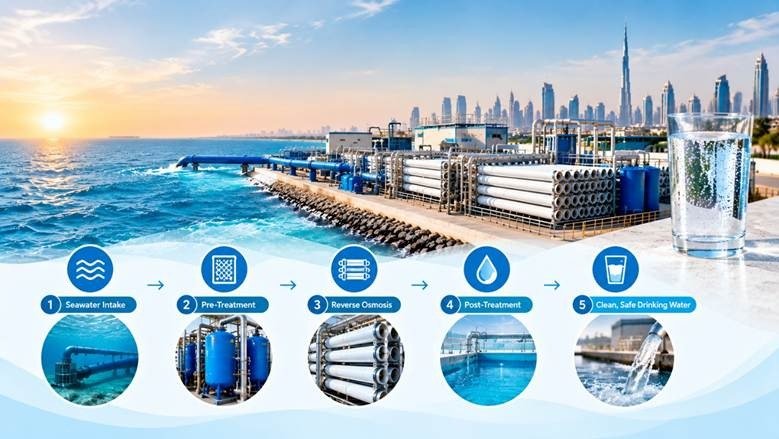
Modern seawater desalination generally involves several stages.
1. Seawater Intake and Pretreatment
Seawater is collected and passed through screening and pretreatment systems to remove particles, suspended solids, and other contaminants that could damage downstream equipment.
Depending on the water quality, pretreatment may include media filtration, ultrafiltration, and cartridge filters. Effective pretreatment helps reduce membrane fouling and supports stable system performance.
2. Reverse Osmosis: Removing Dissolved Salts
After pretreatment, high-pressure pumps push seawater through specialized reverse osmosis membranes. These membranes allow water molecules to pass through while rejecting most dissolved salts and many other impurities.
SWRO membranes UAE desalination projects use is designed for the high salinity of seawater. Selecting the correct membrane depends on feedwater quality, operating pressure, temperature, required production, and the desired water quality.
Businesses sourcing seawater RO membranes UAE should also consider membrane compatibility and manufacturer specifications before choosing a product.
3. Post-Treatment and Disinfection
Water produced by reverse osmosis may require remineralization, pH adjustment, and disinfection before entering a drinking-water distribution system. These processes help achieve the required water quality and ensure the water is suitable for its intended use.
Desalination is therefore not simply about removing salt; the complete treatment process matters.
4. Water Distribution and Brine Management
Once the water meets the applicable quality requirements, it can be supplied to distribution networks or other approved applications.
The remaining concentrated seawater, known as brine, must also be managed carefully. Appropriate discharge design and environmental monitoring help reduce potential impacts on the marine environment.
Choosing the Right RO Membranes
Not every water treatment project uses seawater. Inland facilities across the GCC may treat brackish groundwater, which generally contains less dissolved salt than seawater.
BWRO membranes UAE projects use are designed for brackish-water applications and often operate at lower pressures than seawater systems, depending on feedwater conditions.
When choosing an RO membrane supplier in the UAE, buyers should consider feedwater quality, system requirements, membrane specifications, and long-term operating costs. For seawater desalination, SWRO membranes are designed to handle high salinity, while BWRO membranes are suitable for treating brackish groundwater.
A reliable supplier should offer suitable membrane options, clear technical specifications, and products compatible with the existing treatment system. Selecting the right RO membranes based on water quality, operating pressure, and required output can help improve system efficiency, maintain consistent water production, and reduce unnecessary maintenance costs across water treatment projects in the UAE and wider GCC region.
Choosing suitable desalination RO membranes UAE projects require can help support consistent output, efficient operation, and long-term equipment reliability.
How Can Desalination Plants Improve Efficiency?
Membrane performance depends on more than the product itself. Several practices can help desalination plants manage operating costs and maintain reliable water production:
- Effective pretreatment: Reduces the risk of fouling and scaling.
- Performance monitoring: Tracks water production, salt rejection, and pressure changes.
- Proper maintenance: Helps identify problems before they cause major downtime.
- Suitable membrane selection: Matches membrane specifications to feedwater conditions and production targets.
- Energy management: Efficient pumps and energy recovery equipment can reduce electricity requirements in suitable systems.
These measures are important for municipal plants and facilities using industrial desalination membranes UAE and across the wider GCC.
The Future of Desalination in the GCC
As water demand grows, GCC countries continue to invest in desalination technology, water reuse, and more efficient treatment systems. Improving energy efficiency and managing brine responsibly will remain important priorities.
Advances in membrane technology, automation, and system monitoring can help operators improve reliability and make better use of available resources.
Equipment suppliers also play a role by helping project teams’ source suitable membranes and compatible water treatment components. Aqua Flair Trading LLC supplies water treatment equipment for industrial and commercial applications, supporting customers evaluating solutions for projects in the UAE and wider regional markets.
Frequently Asked Questions
1. How is seawater converted into drinking water?
Seawater is pretreated, passed through reverse osmosis membranes to remove dissolved salts, and then post-treated and disinfected to meet the required drinking-water quality standards.
2. What are SWRO membranes?
Seawater reverse osmosis membranes are designed to separate freshwater from high-salinity seawater under pressure.
3. What is the difference between SWRO and BWRO membranes?
SWRO membranes treat seawater with high salinity, while BWRO membranes are designed for brackish water, which generally has a lower salt concentration.
4. Is desalinated water safe to drink?
Desalinated water can be safe to drink when it receives appropriate post-treatment, meets applicable drinking-water standards, and is properly stored and distributed.
5. How can businesses select the right RO membrane supplier in the UAE?
Businesses should review membrane specifications, feedwater compatibility, product documentation, availability, and technical support before selecting a supplier.
Conclusion
Desalination transforms seawater into a valuable freshwater resource for communities and industries across the GCC. Effective pretreatment, suitable RO membranes, proper post-treatment, and responsible brine management all contribute to a reliable process.
Understanding these stages helps businesses and project developers make informed decisions when planning or upgrading water treatment systems.
