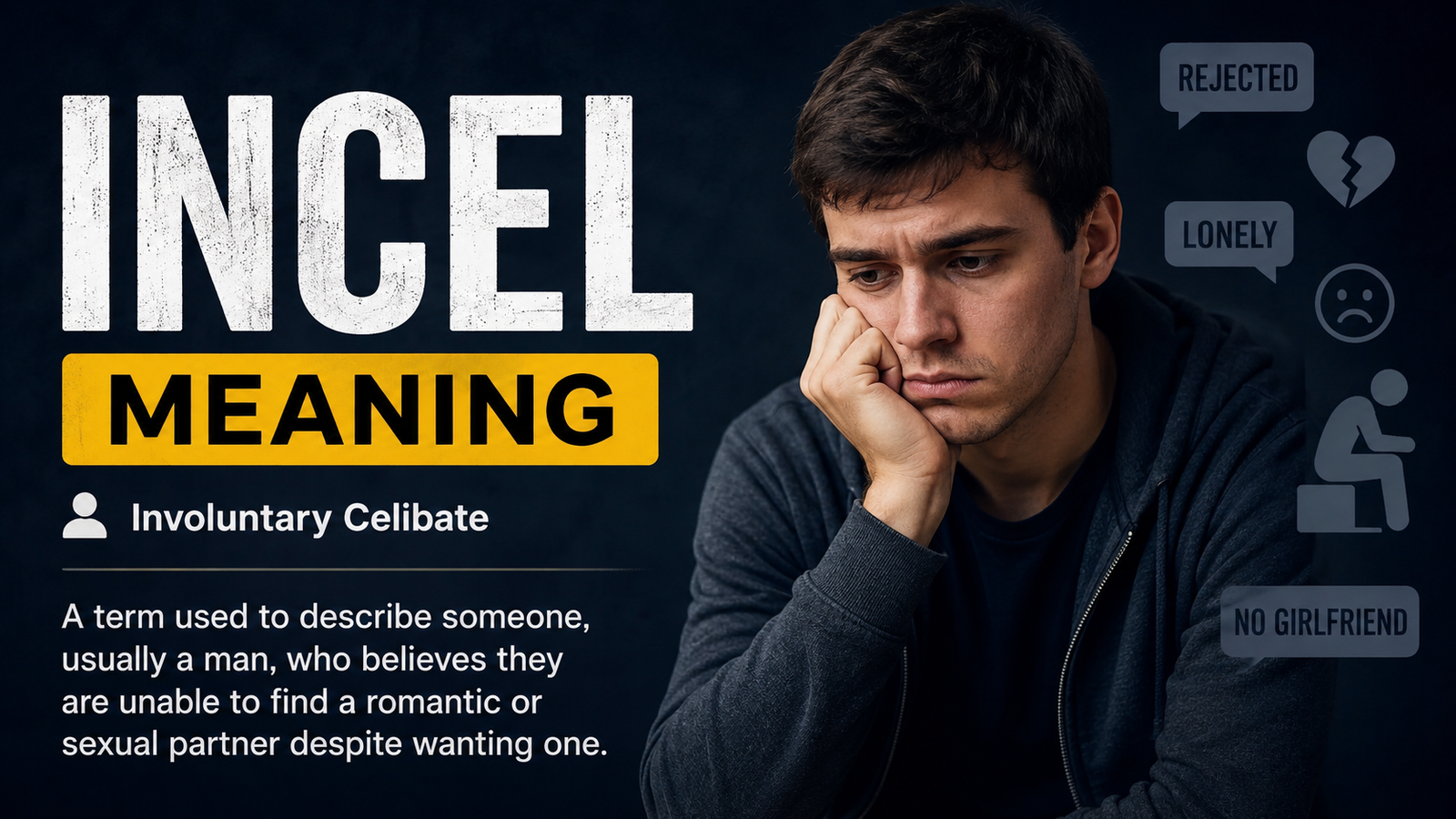
The word incel is an internet term that has changed significantly since it was first created. Today, it usually describes a person, most often a man, who believes he cannot find a romantic or sexual partner despite wanting one. The modern term is also strongly associated with online communities where some members express resentment toward women, dating culture, or society.
The word is short for “involuntary celibate.” Oxford defines an incel as a member of an online community, mostly made up of young men, who feel they are unattractive to women and may hold negative views about women.
However, the history is more complicated than the modern stereotype suggests. The term originally referred more broadly to people who struggled to form romantic or sexual relationships. It was later adopted by online communities that gave it a much more specific and controversial meaning.
If you have seen “incel” in a comment, text, social-media post, news article, or online discussion, this guide explains exactly what it means, how to pronounce it, where it came from, and how it is commonly used.
What Does Incel Mean?
Incel means “involuntary celibate.”
In simple English, it generally refers to someone who wants a romantic or sexual relationship but believes they are unable to get one.
The modern use is more specific than simply being single. A person who has never had a relationship is not automatically an incel. Likewise, someone who is single by choice is not an incel.
Today, incel often refers to an online identity or subculture, particularly one associated with men who believe that women or society unfairly prevent them from having relationships or sexual experiences.
Some online incel communities have developed misogynistic attitudes, meaning hostility, contempt, or prejudice toward women. Researchers have therefore studied incel communities as part of the broader online “manosphere,” although not every lonely or romantically unsuccessful person identifies with that ideology.
Incel Pronunciation
The word incel is pronounced:
/ˈɪnsel/
The pronunciation is straightforward, with the stress on the first syllable. Oxford lists /ˈɪnsel/ as the pronunciation.
Is “Incel” an Acronym?
Not exactly.
Incel is a shortened word, or blend, derived from “involuntary celibate.” It is sometimes casually described as an acronym, but dictionaries more precisely treat it as a shortened or blended form.
Oxford gives its origin as the 1990s, originally appearing in the form “invcel,” from “involuntary” and “celibate.”
Oxford gives its origin as the 1990s, originally appearing in the form “invcel,” from “involuntary” and “celibate.”
Merriam-Webster similarly traces the word to “involuntary celibate” and lists 1999 as its first known use in the meaning defined by the dictionary.
Incel Meaning in Simple English
Here is the easiest way to understand the word:
An incel is generally a person who wants a romantic or sexual relationship but believes they cannot get one, with the modern term often referring to a particular online subculture.
There are two important ideas in this definition:
- The person wants a relationship or sexual connection.
- They believe circumstances outside their control prevent them from getting one.
The second point is especially important because being single does not automatically make someone an incel.
For example, someone might be single because they are focusing on school, work, family, personal goals, or simply because they have not met the right person. That person would not normally be called an incel.
Origin and History of the Word “Incel”
The history of incel is one of the most interesting aspects of the term.
The word originated in the 1990s, when a Canadian woman known online as Alana created an online support project for people experiencing difficulties with romantic and sexual relationships. Research published in 2025 describes her project as a support group open to people of different genders who struggled to form relationships.
The original community was not created as an anti-woman movement. Its purpose was closer to peer support: people could discuss loneliness, dating difficulties, shyness, and problems forming relationships.
Over time, however, the meaning of the word changed.
As internet forums and online communities developed, the term became increasingly associated with groups of men who described themselves as permanently excluded from dating and who sometimes blamed women or society for their situation. Academic research notes that the modern community became substantially different from the original inclusive project.
This evolution explains why incel can mean slightly different things depending on context.
How the Meaning Changed Over Time
The original meaning was relatively broad.
It could describe someone who wanted a relationship but had difficulty finding one. Gender was not necessarily central to the definition.
The modern meaning is considerably narrower.
Today, the word commonly brings to mind online communities dominated by men who discuss dating rejection, physical appearance, perceived social status, and sexual frustration. Some of these communities have promoted misogynistic ideas and hostile attitudes toward women.
This distinction matters because loneliness and incel ideology are not the same thing.
A person can experience loneliness, rejection, or difficulty dating without adopting an incel identity or hostile beliefs.
What Does Incel Mean Online?
On the internet, incel can be used in several ways.
1. As a self-description
Someone may call themselves an incel because they believe they are unable to find a partner despite wanting one.
2. As a description of an online subculture
News organizations and researchers often use the word to describe online communities centered around involuntary celibacy and related beliefs.
3. As an insult
People sometimes use incel as an insult toward a man they believe is bitter about women, unsuccessful in dating, or hostile toward women.
This third usage can be inaccurate. Calling every socially awkward, lonely, or single man an incel ignores the specific cultural meaning the term has developed.
Examples of “Incel” in a Sentence
Here are some neutral examples showing how the word can appear in everyday writing:
- “The article discusses the history of the incel movement.”
- “He used the word incel to describe an online community.”
- “Being single does not automatically mean someone is an incel.”
- “The documentary examines how incel forums developed online.”
- “Researchers have studied incel communities and their attitudes toward relationships.”
These examples show that the word can describe either an individual or a broader online subculture.
Incel Meaning in Texting and Social Media
On social media, incel is usually used in a more informal and sometimes insulting way.
For example:
“He sounds like an incel.”
This could mean that the speaker thinks the person is bitter about dating or expresses hostility toward women.
Another example is:
“That forum is full of incel discussions.”
Here, the word refers to a particular online culture rather than simply describing someone who is single.
Because the term can be insulting, it is better to understand the context before using it to describe another person.
Is Being Single the Same as Being an Incel?
No.
This is one of the most important distinctions.
Millions of people are single at different points in their lives. Being single may be voluntary or simply a temporary circumstance.
The term incel usually carries additional meaning involving a person’s belief that they are involuntarily excluded from romantic or sexual relationships. In modern usage, it can also refer to participation in a particular online subculture.
Therefore:
Single ≠ automatically incel
Someone can be single without identifying with the term or its associated online culture.
Incel vs. Celibate
The words incel and celibate are related but not identical.
Celibate generally describes someone who abstains from sexual activity, whether voluntarily or for other reasons.
Incel, by contrast, specifically contains the idea of involuntary celibacy or unwanted lack of sexual or romantic relationships.
For example, someone who deliberately chooses not to have sexual relationships may be celibate but would not normally be called an incel.
Incel vs. Lonely
These words should also not be treated as synonyms.
Lonely describes an emotional state or feeling of social isolation.
Incel is a label connected to unwanted romantic or sexual relationships and, in contemporary usage, a specific online subculture.
A person can be lonely without being an incel, and someone who identifies with incel communities may describe loneliness as part of their experience.
Synonyms for Incel
There is no perfect synonym for incel, especially because the word has developed a specialized cultural meaning.
Depending on context, related expressions include:
- Involuntary celibate
- Romantically frustrated person
- Sexually frustrated person
- Person experiencing unwanted celibacy
- Dating-frustrated person
However, these expressions are not interchangeable in every situation.
For example, involuntary celibate describes the literal meaning of the word, while incel can also refer to the modern online subculture.
Antonyms of Incel
There is no exact dictionary antonym for incel.
Depending on what aspect of the word you mean, possible contrasts include:
- Voluntarily celibate
- Sexually active person
- Person in a relationship
- Romantically fulfilled person
- Person who chooses to remain single
These are contextual opposites rather than strict dictionary antonyms.
For example, someone who chooses to remain single could be described as voluntarily celibate, which contrasts with the “involuntary” part of incel.
Common Terms Associated With Incel Communities
People researching the topic may encounter several specialized expressions online.
One is “black pill,” a term associated with an especially pessimistic worldview in some incel communities. Research has examined how this worldview can involve beliefs that romantic outcomes are largely determined by physical appearance and other supposedly fixed characteristics.
Another commonly discussed term is “Chad,” which some incel communities use as a stereotype for a conventionally attractive or socially successful man.
These terms are not ordinary English vocabulary. They are strongly connected with specific online communities and should be understood in context.
Why Is the Word “Incel” Controversial?
The controversy comes largely from the modern subculture associated with the term.
Researchers have documented misogynistic and dehumanizing ideas in some incel communities. Some online spaces have also been connected with discussions of violence and extremist thinking.
That does not mean every person who experiences loneliness or difficulty dating is violent or misogynistic.
It is important to separate personal circumstances from ideology.
Feeling rejected or lonely is a human experience. Turning those feelings into hatred, entitlement, harassment, or threats toward other people is a separate issue.
How Should You Use the Word “Incel”?
Use the term carefully.
If you are writing an article, report, or academic piece, it is best to explain what definition you mean.
For example:
“The term incel originally referred to involuntary celibacy but is now commonly associated with an online subculture of men who describe themselves as unable to find romantic or sexual partners.”
This wording avoids assuming that every person who has difficulty dating belongs to the modern incel movement.
In casual conversation, calling someone an incel can be insulting, so using the word without understanding the context may create unnecessary conflict.
Is “Incel” a Bad Word?
Incel is not a swear word, but it can be derogatory depending on how it is used.
In academic or journalistic writing, it can be a neutral term when describing the phenomenon or online communities.
In everyday arguments, however, it is often used as an insult.
The meaning therefore depends heavily on context, tone, and intention.
Frequently Asked Questions About Incel Meaning
What does incel stand for?
Incel stands for “involuntary celibate.” It originally described people who wanted romantic or sexual relationships but were unable to find them.
What does incel mean in simple words?
In simple English, an incel is generally someone who believes they cannot find a romantic or sexual partner even though they want one. Today, the term is also strongly associated with a particular online subculture.
How do you pronounce incel?
The standard pronunciation is /ˈɪnsel/. The stress falls on the first syllable.
When was the word incel invented?
The term originated in the 1990s. Merriam-Webster lists 1999 as its first known use in the modern dictionary sense, while historical and academic sources trace its development to Alana’s online project in the late 1990s.
Is every single man an incel?
No. Being single does not make someone an incel. The term has a more specific meaning involving unwanted romantic or sexual isolation and, in contemporary usage, an associated online identity or subculture.
Is incel an insult?
It can be. Although the word can be used neutrally in academic or journalistic discussions, people frequently use it as an insult when accusing someone of being bitter, misogynistic, or hostile toward women.
Does incel only refer to men?
Historically, no. The original community associated with the term was intended to include people of different genders and sexual orientations. Modern popular usage, however, overwhelmingly associates the term with men, particularly online communities of men who describe themselves as involuntarily celibate.
Is incel the same as misogynist?
No. The terms describe different things. Misogynist refers to someone who expresses hatred, contempt, or prejudice toward women. Incel refers to involuntary celibacy and, in modern usage, a related online subculture. Some incel communities have strong misogynistic elements, but the words are not technically synonyms.
Final Thoughts on Incel Meaning
The simplest definition of incel is “involuntary celibate,” but that definition alone does not capture the word’s modern meaning.
The term began in the 1990s as a way to describe people struggling with unwanted romantic or sexual isolation. Its original community was intended to provide support and discussion for people facing those difficulties.
Over time, the word was adopted by online communities, particularly groups of men, and became associated with resentment toward dating, women, and society. Some of these communities have developed explicitly misogynistic or extremist ideas, which is why incel now carries a much heavier cultural meaning than its original definition.
Understanding that history is important. Being lonely, single, rejected, or inexperienced in relationships does not automatically make someone an incel. The modern term is connected not only with relationship difficulties but also with a particular online identity and, in some contexts, a set of hostile beliefs.
So, when you encounter “incel meaning” online, remember the key distinction: the literal meaning refers to unwanted celibacy, while the contemporary cultural meaning often refers to a specific and controversial online subculture.