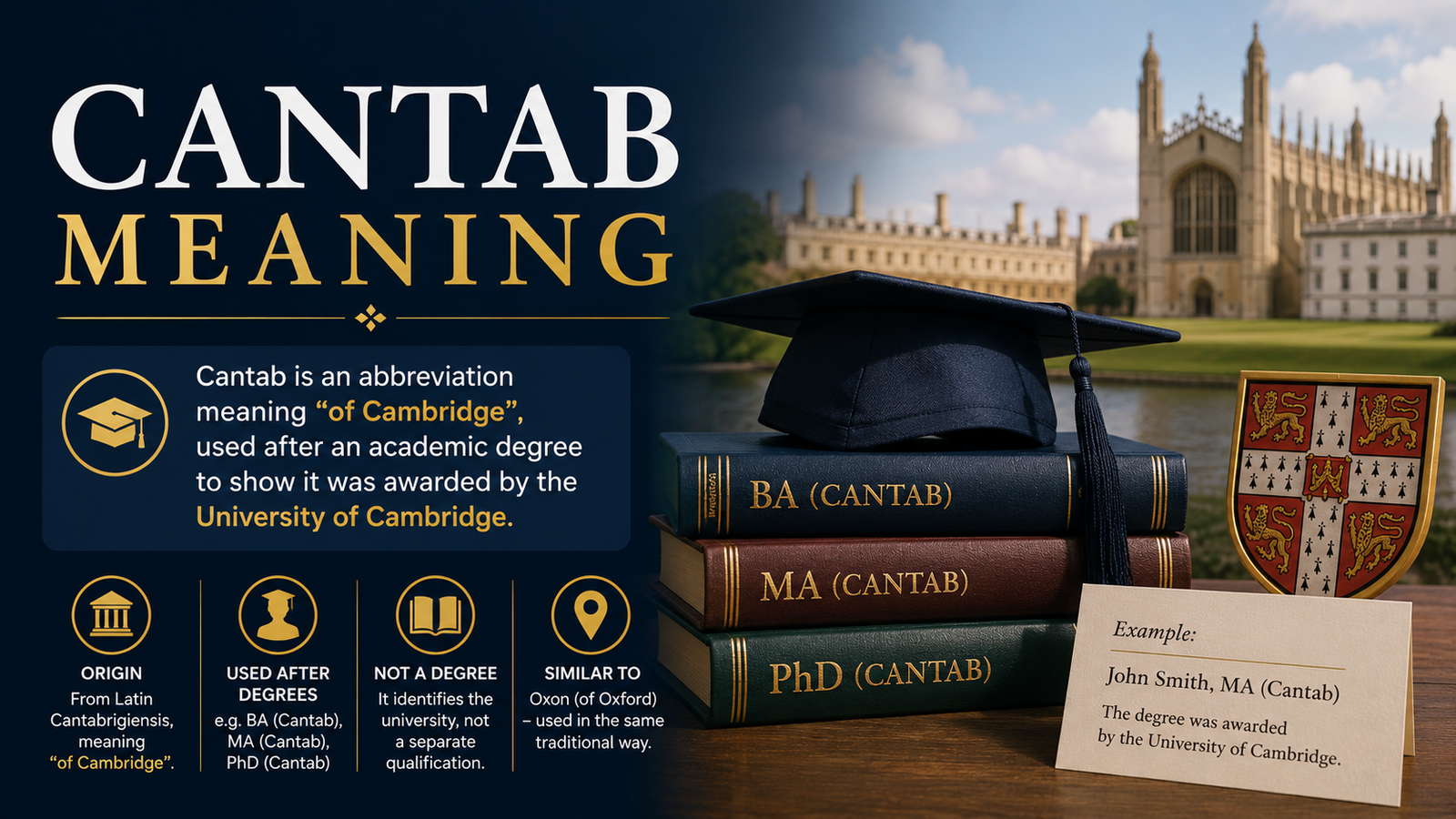
If you have ever seen “Cantab” written after a person’s academic degree, you may have wondered what it means. It looks unusual because it is not an everyday English word, but its meaning is actually quite straightforward.
Cantab is an abbreviation connected with Cambridge University, especially when it appears after an academic qualification. For example, BA (Cantab) indicates a Bachelor of Arts degree awarded by the University of Cambridge. The Cambridge Dictionary defines “Cantab.” as an abbreviation for Cambridge used after someone’s name and qualifications to show that they have a Cambridge degree.
The word has a long academic history and comes from Latin. Oxford traces it to Cantabrigiensis, meaning “of Cambridge.”
This guide explains the Cantab meaning, pronunciation, origin, examples, synonyms, antonyms, common usage, and frequently asked questions in simple English.
What Does Cantab Mean?
The simplest definition of Cantab is:
Cantab is a traditional abbreviation meaning “of Cambridge,” particularly used with academic degrees awarded by the University of Cambridge.
You may see it written like this:
- BA (Cantab)
- MA (Cantab)
- PhD (Cantab)
- MEng (Cantab)
In these examples, Cantab does not name another degree. Instead, it identifies the university associated with the qualification.
For example:
Jane Smith, MA (Cantab)
This tells the reader that Jane Smith holds an MA associated with the University of Cambridge.
Cambridge itself uses the form BA Hons. (Cantab.) for its undergraduate degrees, showing that the abbreviation remains part of the university’s traditional academic terminology.
Cantab Meaning in Simple English
In everyday language, you can think of Cantab as meaning:
“from Cambridge” or “of Cambridge.”
When it appears after a degree, it usually means:
“This degree is from the University of Cambridge.”
So if you see:
John Brown, BA (Cantab)
you can understand it as:
John Brown, Bachelor of Arts, Cambridge.
This is why the term often appears in academic biographies, professional profiles, historical documents, and formal descriptions of qualifications.
How Do You Pronounce Cantab?
The standard pronunciation of Cantab is represented by Oxfordhttps://www.indeed.com/career-advice/career-development/types-of-academic-degrees as:
/ˈkæntæb/
The stress falls on the first syllable.
The word has two simple syllables, and the pronunciation is fairly close to the sound of “can” + “tab.”
Because it is an abbreviation derived from Latin rather than an ordinary modern English word, people who have never encountered it may be unsure how to say it.
Origin of the Word Cantab
The history of Cantab goes back to Latin.
Oxford gives its origin as Cantabrigiensis, meaning “of Cambridge.” The Latin form is related to Cantabrigia, a Latinized name for Cambridge.
The longer form Cantabrigian also developed from this historical Latin name. Etymological sources record Cantabrigian from the 16th century and the shortened form Cantab from around the 18th century in the sense of a member or graduate of the University of Cambridge.
Over centuries, universities frequently used Latin terminology in academic documents. Some of these traditional forms have survived into modern academic writing.
That is why Cantab can look strange to modern English speakers: it comes from an older academic naming tradition rather than from ordinary contemporary vocabulary.
What Is Cantabrigensis?
Cantabrigiensis is the Latin word behind Cantab.
Its basic sense is “of Cambridge” or “belonging to Cambridge.”
The term became particularly useful in academic contexts because universities traditionally used Latin for degree titles, scholarly documents, and formal credentials.
Eventually, Cantabrigiensis was shortened to Cantab for practical use.
This is similar to another famous academic abbreviation:
Oxon
Oxon comes from Oxoniensis, the Latin form meaning “of Oxford.” Oxford’s own dictionary explains the contrast between Oxon and Cantab in the context of Oxford and Cambridge degrees.
Cantab After a Degree
One of the most important things to understand about Cantab is its position after a qualification.
It may appear like this:
BA (Cantab)
or:
MA (Cantab)
The degree comes first, while Cantab identifies Cambridge as the institution connected with the qualification.
Here are some examples:
BA (Cantab)
This means a Bachelor of Arts associated with the University of Cambridge.
MA (Cantab)
This means a Master of Arts associated with Cambridge.
There is a particular Cambridge tradition behind the MA designation. Cambridge undergraduates receive a BA and, after the required period and conditions, can have it converted to an MA without undertaking further study. Oxford also notes this distinction when explaining the traditional use of MA (Cantab) and MA (Oxon).
PhD (Cantab)
This indicates a PhD awarded by the University of Cambridge.
MEng (Cantab)
This can identify a Master of Engineering qualification associated with Cambridge.
The exact qualification and university regulations always matter, but the key idea remains the same: Cantab identifies Cambridge in a traditional academic form.
Is Cantab a Degree?
No. Cantab is not a degree.
This is one of the most common misunderstandings.
A degree is something such as:
- BA
- MA
- BSc
- MEng
- PhD
Cantab is an abbreviation indicating Cambridge.
Therefore:
BA (Cantab)
should not be interpreted as a degree called “Cantab.”
Instead, it means a BA with a Cambridge designation.
Cantab vs. Cambridge
Although the two words are closely related, they are not interchangeable in every situation.
Cambridge is the normal English name of the university and city.
Cantab is a traditional Latin-derived abbreviation used particularly in academic contexts.
For example:
She studied at Cambridge.
This is normal everyday English.
But:
She earned a BA (Cantab).
This is a formal academic style.
So, Cantab is essentially a specialized shorthand rather than an alternative everyday name for Cambridge.
Cantab Meaning as a Person
The word can also be used informally as a noun to describe a person connected with Cambridge, especially a student or graduate.
Historical and dictionary sources record Cantab as a colloquial term for a Cambridge graduate or member of the University of Cambridge.
For example:
He is a Cantab who studied history at Cambridge.
In this sentence, Cantab refers to the person rather than appearing after a degree.
The plural form can be Cantabs.
This usage is less common in everyday international English, so readers unfamiliar with Cambridge traditions may find it unusual.
Examples of Cantab in Sentences
Understanding examples makes the word much easier to recognize.
Academic Examples
1. Dr. James Wilson, MA (Cantab), works as a historian.
Here, Cantab shows the Cambridge connection of the degree.
2. She graduated with a BA (Cantab).
The sentence identifies the qualification as a Cambridge degree.
3. His profile lists a PhD (Cantab).
This indicates a PhD from Cambridge.
Professional Examples
4. The speaker, an experienced Cantab, discussed the history of British universities.
Here, Cantab refers to someone associated with Cambridge.
5. Her formal biography includes her MA (Cantab).
The abbreviation appears in a professional academic context.
Historical Examples
6. Several young Cantabs traveled from Cambridge to London.
Here, the term is being used as a noun for Cambridge students or graduates.
Common Uses of Cantab
You are most likely to encounter Cantab in the following places:
1. Academic Credentials
This is the clearest and most important use.
You may see it after degree abbreviations on:
- Academic biographies
- University profiles
- Books
- Research papers
- Professional biographies
- Historical records
- Formal correspondence
2. Professional Profiles
A person may include MA (Cantab) or another qualification in a biography or professional profile.
It provides a compact way of identifying the awarding institution.
3. Historical Writing
Because the abbreviation has a long history, writers discussing Cambridge academics, graduates, or university traditions may use Cantab.
4. Informal Reference to Cambridge People
In some contexts, Cantab can refer to a Cambridge student or graduate.
This usage is more specialized and is less likely to appear in ordinary conversation.
Synonyms for Cantab
The best synonym depends on how Cantab is being used.
When referring to a person connected with Cambridge, possible alternatives include:
- Cambridge graduate
- Cambridge alumnus
- Cambridge alumna
- Cambridge student
- Cambridge scholar
- Cantabrigian
When referring to the abbreviation after a degree, however, there is no perfect everyday synonym.
You could explain it as:
“of Cambridge”
or:
“from the University of Cambridge.”
These explain the meaning rather than functioning as exact replacements.
Antonyms of Cantab
There is no direct antonym for Cantab because it is primarily an institutional and historical abbreviation.
However, in the traditional Oxford-Cambridge academic comparison, Oxon can be considered its counterpart.
Cantab = of Cambridge
Oxon = of Oxford
Oxford’s dictionary specifically explains these Latin-derived abbreviations in the context of academic degrees.
For example:
MA (Cantab) → Cambridge
MA (Oxon) → Oxford
They are not true opposites in the normal linguistic sense, but they serve parallel academic functions.
Cantab vs. Cantabrigian
These words are closely connected.
Cantabrigian is the longer term and can mean something relating to Cambridge or a person connected with Cambridge.
Cantab is the shortened form.
A simple way to remember the relationship is:
Cantabrigian → Cantab
The shortened form is particularly well established in academic usage.
Etymological sources identify Cantab as a shortening of Cantabrigian, which ultimately comes from the Latinized name Cantabrigia for Cambridge.
Is Cantab a Slang Word?
Not really.
Although Cantab can be used informally as a noun for a Cambridge student or graduate, it is primarily a traditional academic abbreviation.
It is therefore better described as formal, historical, or academic vocabulary rather than internet slang.
You would not normally use it as a casual texting abbreviation.
For example, it would be unusual to text a friend:
“I met a Cantab today.”
unless the conversation is specifically about Cambridge.
Common Mistakes About Cantab
Mistake 1: Thinking Cantab Is an Acronym
Cantab is better understood as a shortened Latin-derived form, not a modern acronym made from the first letters of several English words.
Mistake 2: Thinking It Is a Degree
It is not a degree.
BA, MA, and PhD are qualifications. Cantab identifies Cambridge.
Mistake 3: Assuming It Means Any Cambridge
The academic use generally points to the University of Cambridge in England.
There are other places called Cambridge, including Cambridge, Massachusetts, so context matters. The academic post-nominal use is specifically associated with Cambridge University.
Mistake 4: Treating It Like Everyday English
You are much more likely to see Cantab in an academic or formal context than in casual conversation.
Why Is Cantab Still Used Today?
At first, an old Latin abbreviation might seem unnecessary in modern English.
But academic traditions can be remarkably durable.
Cambridge continues to use Cantab. as part of its traditional degree terminology. Its undergraduate information, for example, refers to graduates receiving a BA Hons. (Cantab.).
The abbreviation is also useful because it communicates a lot in very little space.
Instead of writing:
Bachelor of Arts degree awarded by the University of Cambridge
a formal credential can simply use:
BA (Cantab)
That compact style is one reason traditional academic abbreviations have survived.
Cantab in Modern Online Profiles
Today, you may encounter Cantab outside printed academic documents.
For example, someone may list:
BA (Cantab), MA
on a professional biography.
You may also see it in:
- Author biographies
- University websites
- Academic conference profiles
- Legal profiles
- Historical biographies
- Research publications
If you see Cantab after a qualification, the safest interpretation is usually that it identifies a Cambridge qualification.
Quick Meaning of Cantab
| Feature | Meaning |
|---|---|
| Word | Cantab |
| Type | Abbreviation / shortened form |
| Basic meaning | Of Cambridge |
| Academic meaning | Associated with a Cambridge degree |
| Origin | Latin |
| Longer form | Cantabrigiensis / Cantabrigian |
| University | University of Cambridge |
| Pronunciation | /ˈkæntæb/ |
| Example | BA (Cantab) |
| Opposing counterpart | Oxon, for Oxford |
Frequently Asked Questions About Cantab
What does Cantab mean?
Cantab means “of Cambridge” and is commonly used as a traditional abbreviation connected with the University of Cambridge. When it follows a degree, it indicates a Cambridge qualification.
What does BA (Cantab) mean?
BA (Cantab) means a Bachelor of Arts degree associated with the University of Cambridge.
Is Cantab short for Cambridge?
Yes, in practical terms it is a traditional abbreviation associated with Cambridge. Its deeper origin is the Latin Cantabrigiensis, meaning “of Cambridge.”
How do you pronounce Cantab?
The Oxford pronunciation is /ˈkæntæb/. The main stress is on the first syllable.
Is Cantab the same as Cantabrigian?
They are closely related, but not identical in form. Cantabrigian is the longer term, while Cantab is a shortened form that has long been associated with Cambridge.
Is Cantab a degree?
No. Cantab is not a degree. It is a designation associated with Cambridge. A qualification such as BA, MA, or PhD is the actual degree.
What is the opposite of Cantab?
There is no strict opposite, but Oxon is its traditional counterpart because it refers to Oxford in the same Latin-derived academic style.
Can Cantab refer to a person?
Yes. In colloquial usage, Cantab can refer to a student or graduate of Cambridge. The plural is Cantabs.
Final Thoughts on Cantab Meaning
The Cantab meaning becomes much less mysterious once you know its Latin background. In simple terms, Cantab means “of Cambridge” and is especially familiar as a traditional academic abbreviation used with Cambridge qualifications.
If you see BA (Cantab), MA (Cantab), or PhD (Cantab), you can immediately understand that Cantab identifies Cambridge.
The word comes from the Latin Cantabrigiensis, through the historical forms associated with Cambridge. Its continued use is a good example of how centuries-old academic traditions can remain relevant in modern professional and educational writing.
So, the next time you see Cantab after someone’s name, there is no need to wonder whether it is a secret title or a separate qualification. It is simply a concise, traditional way of connecting that academic credential—or, in some contexts, that person—with Cambridge.