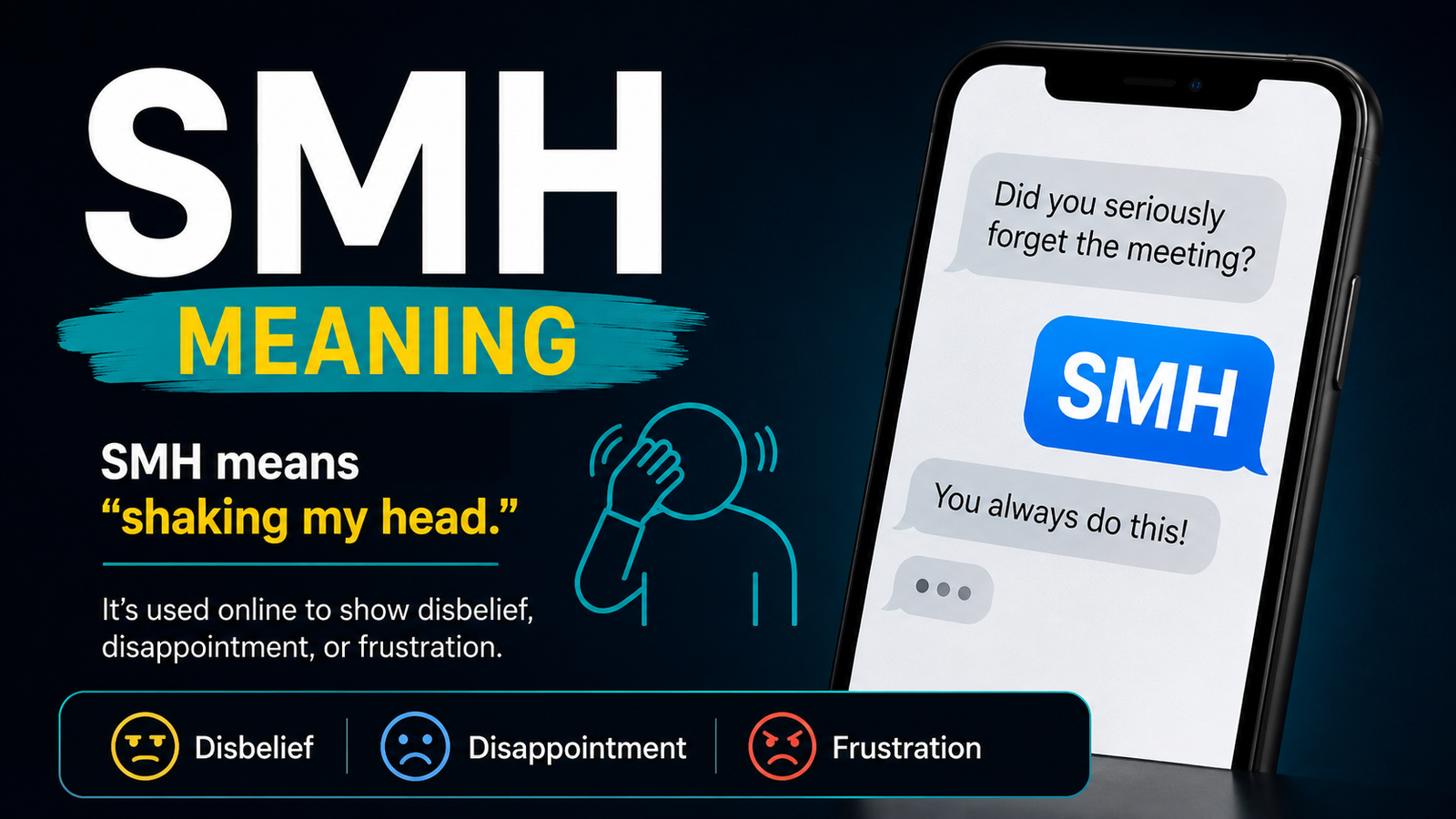
If you have ever received a text that simply says “SMH”, you may have wondered what those three letters actually mean. In online conversations, SMH means “shaking my head.” People use it to show disbelief, disappointment, frustration, annoyance, or disapproval without writing a long response.
The expression comes from the familiar physical gesture of shaking your head when something seems ridiculous, surprising, frustrating, or difficult to believe. In digital communication, SMH turns that silent reaction into three quick letters.
Today, SMH is widely used in text messages, social media posts, comments, group chats, forums, and other informal online conversations. Cambridge Dictionary defines SMH as an abbreviation for “shaking my head” and notes that it is used when someone does not believe or approve of something.
This guide explains the SMH meaning, pronunciation, origin, examples, synonyms, antonyms, common uses, variations, and frequently asked questions in simple English.
What Does SMH Mean?
SMH stands for “shaking my head.”
It is an internet slang abbreviation used as a reaction to something that seems:
- Ridiculous
- Disappointing
- Frustrating
- Unbelievable
- Annoying
- Silly
- Irresponsible
- Hard to understand
In simple terms, SMH is like saying, “I can’t believe this,” “Seriously?” or “What were you thinking?”
Merriam-Webster describes SMH as an informal abbreviation meaning “shaking my head” and says it is used to express disapproval, dismay, or disbelief.
For example:
“He forgot his keys again. SMH.”
The person is not necessarily angry. They are expressing frustration or disbelief at the situation.
Another example:
“You studied all night and forgot to submit the assignment? SMH.”
Here, SMH communicates a reaction that might otherwise be expressed through a head shake, sigh, or “I can’t believe you did that.”
How Do You Pronounce SMH?
SMH is an initialism, so people normally pronounce each letter separately rather than saying it as one word.
The usual pronunciation is:
“Ess-em-aitch.”
You generally would not pronounce SMH like a normal English word. In casual speech, someone might simply say “SMH” aloud when referring to the expression.
What Does “Shaking My Head” Literally Mean?
The phrase comes from a real-world body-language reaction.
Imagine someone tells you:
“I left my phone at home, drove 30 minutes to work, and then realized I needed it.”
You might naturally shake your head because the situation is frustrating or silly.
Online, SMH represents that reaction in written form.
This is one reason internet abbreviations can be so useful. Text messages cannot easily show facial expressions, gestures, or tone. A short expression such as SMH helps fill that gap.
Instead of typing:
“I honestly cannot believe you did that. That was such a silly decision.”
someone can simply write:
“SMH.”
The meaning depends heavily on context and the relationship between the people communicating.
SMH Origin and History
The exact moment when SMH was first created is difficult to establish. Internet slang often develops gradually through online communities rather than having one identifiable inventor.
However, documented uses of SMH date back to at least the 1990s. Merriam-Webster notes an example from a 1994 Usenet discussion that defined SMH as “shaking my head.”
The abbreviation later became more visible as text messaging, online forums, social media, and instant messaging grew.
Dictionary.com explains that the term became increasingly associated with internet communication and notes its appearance in online slang during the 2000s.
By the 2010s, SMH had become familiar to a much wider internet audience. People began using it regularly on social platforms, discussion boards, comments, and messaging apps.
Today, dictionaries such as Merriam-Webster, Cambridge Dictionary, and Collins recognize SMH as an established informal abbreviation.
Why Is SMH So Popular?
One major reason is convenience.
Online communication is fast. People often want to respond emotionally without typing a complete sentence. SMH gives them a quick way to communicate a reaction.
Compare these two responses:
“I can’t believe you made that mistake again.”
and:
“SMH.”
The second response is much shorter, but the emotional meaning can still be clear.
SMH also works because people understand the physical gesture behind it. Shaking your head is a familiar human reaction to disbelief, disappointment, or frustration.
Common Uses of SMH
1. Expressing Disbelief
SMH can show that you cannot believe what someone has said or done.
Example:
“He said he forgot his own birthday. SMH.”
The writer finds the situation difficult to believe.
2. Showing Disappointment
People often use SMH when someone makes a poor choice.
Example:
“She had one job and still forgot the tickets. SMH.”
The expression communicates disappointment without necessarily sounding furious.
3. Showing Mild Frustration
SMH can also communicate everyday annoyance.
Example:
“The Wi-Fi stopped working right before my presentation. SMH.”
Here, the writer is frustrated by the situation.
4. Reacting to Something Silly
SMH is frequently used when someone makes an obvious or silly mistake.
Example:
“I put my coffee in the refrigerator instead of the cupboard. SMH.”
In this case, the writer may be laughing at their own mistake.
5. Criticizing a Bad Decision
Someone might use SMH after describing an irresponsible or questionable action.
Example:
“He knew the road was closed and still tried to drive through it. SMH.”
The abbreviation signals disapproval.
6. Using SMH Against Yourself
SMH does not always target another person. You can use it to react to your own mistake.
Example:
“I spent 20 minutes looking for my glasses. They were on my head. SMH.”
This use is often humorous and self-deprecating.
SMH Examples in Text Messages
Here are some natural examples of how people may use SMH in everyday digital communication.
Friend: I missed the bus because I was watching videos.
Reply: SMH 😂
Friend: I ordered food and accidentally entered my old address.
Reply: SMH. How did you manage that?
Friend: I studied the wrong chapter for the test.
Reply: Oh no, SMH 😭
Post: I forgot my umbrella on the rainiest day of the year.
Comment: SMH.
Message: They increased the price again.
Reply: SMH. That’s ridiculous.
These examples show that SMH can be serious, playful, sarcastic, or mildly critical depending on the conversation.
SMH in Social Media
SMH is especially common in informal online communication.
You may see it in:
- Instagram comments
- TikTok comments
- Facebook posts
- X posts and replies
- Reddit discussions
- Group chats
- Text messages
- Online forums
- Memes
On social media, SMH often appears at the beginning or end of a sentence.
For example:
“SMH, people really believe this.”
Or:
“People really believe this, smh.”
Both communicate a similar reaction.
What Does SMH Mean in Texting?
In texting, SMH means “shaking my head.”
It usually communicates a quick emotional reaction rather than a literal statement that the person is physically shaking their head.
For example:
“You forgot your wallet again? SMH.”
This could mean:
“Come on, seriously?”
or:
“I can’t believe you did that again.”
The exact emotion depends on context.
It may be playful between close friends but more critical when used during an argument.
What Does SMH Mean on Social Media?
On social media, SMH generally has the same meaning: “shaking my head.”
It can express disbelief, disappointment, frustration, or disapproval. Cambridge specifically describes it as a social-media and texting abbreviation used when someone does not believe or approve of something.
For example:
“They had one simple task and still got it wrong. SMH.”
The writer is expressing frustration with the situation.
Is SMH Rude?
SMH is not automatically rude, but it can sound dismissive or judgmental.
The tone depends on the situation.
If a friend makes a harmless mistake, you might write:
“SMH 😂”
and everyone understands it as a joke.
However, if someone is discussing a serious issue and you respond only with:
“SMH.”
they may interpret it as criticism or disrespect.
When communicating professionally, it is usually better to write your reaction clearly rather than rely on slang.
SMH Synonyms
There is no perfect one-word synonym for SMH because it communicates both an idea and an emotional reaction. However, several expressions can convey a similar meaning.
Common alternatives include:
- I can’t believe it
- Seriously?
- Come on
- That’s ridiculous
- What were you thinking?
- Unbelievable
- That’s disappointing
- I don’t even know what to say
- You’ve got to be kidding
- Oh, please
- Facepalm
- Rolling my eyes
The best alternative depends on the emotion you want to express.
For example, “Seriously?” may sound more direct, while “I can’t believe it” sounds more explanatory.
SMH Antonyms
SMH does not have exact antonyms because it is an expression rather than a traditional adjective or verb.
Still, expressions with the opposite emotional direction can include:
- Well done
- Good job
- I agree
- That’s impressive
- Exactly
- Absolutely
- I’m proud of you
- Great idea
- That makes sense
- I approve
For example:
SMH: “That was a terrible decision.”
Opposite reaction:
“Great decision!”
The exact opposite depends on the context.
SMH vs. SMDH
A common variation of SMH is SMDH, which means:
“Shaking My Damn Head.”
It carries essentially the same basic idea as SMH but adds stronger emphasis.
Merriam-Webster lists SMDH as a variant of SMH.
For example:
“You did it again? SMDH.”
Compared with:
“You did it again? SMH.”
The first version generally sounds more frustrated or emphatic.
Because SMDH contains a mild swear word, SMH is the safer choice in many situations.
Does SMH Ever Mean Something Else?
“Shaking my head” is overwhelmingly the standard meaning of SMH in modern internet slang.
However, other interpretations can occasionally appear depending on the community or context. Some dictionaries and slang references mention “scratching my head” as another possible interpretation.
That alternative is much less common.
Therefore, if you see:
“SMH, I can’t believe he did that.”
the intended meaning is almost certainly:
“Shaking my head.”
Always look at the surrounding words if an abbreviation seems unclear.
Is SMH an Acronym or Initialism?
Technically, SMH is better described as an initialism.
An acronym is normally pronounced as a word, such as “NASA.”
An initialism is pronounced using individual letters, such as “FBI” or “SMH.”
Since SMH is normally pronounced “ess-em-aitch,” calling it an initialism is more precise.
In everyday conversations, however, people may simply call it an acronym, abbreviation, or internet slang. The important point is understanding what it means.
When Should You Use SMH?
SMH works best in casual communication.
Good situations include:
- Texting friends
- Casual group chats
- Social media comments
- Memes
- Informal online discussions
- Casual conversations
It is less suitable for:
- Formal emails
- Job applications
- Academic essays
- Business reports
- Professional complaints
- Official documents
Instead of writing:
“SMH, your company made another mistake.”
in a formal complaint, you could write:
“I am disappointed that the same issue has occurred again.”
The second version communicates your concern more professionally.
How to Use SMH Correctly
Using SMH is simple.
At the beginning
“SMH, I can’t believe this happened.”
At the end
“I forgot my password again, SMH.”
As a standalone reaction
“SMH.”
With humor
“I walked into the wrong classroom for ten minutes. SMH 😂.”
The most important thing is tone. SMH is usually informal and should match the atmosphere of the conversation.
Frequently Asked Questions About SMH
What does SMH mean?
SMH means “shaking my head.” It is an informal internet abbreviation used to express disbelief, disappointment, frustration, or disapproval.
What does SMH mean in texting?
In texting, SMH means “shaking my head.” It is a short reaction to something that seems silly, frustrating, unbelievable, or disappointing.
How do you pronounce SMH?
SMH is pronounced by saying each letter separately: “ess-em-aitch.”
Is SMH a bad word?
No. SMH is not a swear word. It is informal slang. However, depending on context, it can sound dismissive or critical.
What does SMH mean on Instagram?
On Instagram, SMH usually means “shaking my head.” People use it in comments, captions, or replies when reacting to something they find unbelievable, disappointing, or frustrating.
What is the difference between SMH and SMDH?
SMH means “shaking my head,” while SMDH means “shaking my damn head.” SMDH generally expresses stronger frustration.
Can I use SMH professionally?
It is better to avoid SMH in formal professional communication. Use a clear phrase such as “I am disappointed,” “I disagree,” or “I cannot believe this happened.”
Can SMH be used jokingly?
Yes. Friends frequently use SMH humorously when someone makes a harmless mistake.
For example:
“I looked everywhere for my phone while holding it. SMH 😂.”
Does SMH always mean anger?
No. SMH can express disbelief, amusement, disappointment, frustration, or mild annoyance. The meaning depends on context and tone.
Final Thoughts on SMH Meaning
The SMH meaning is simple: “shaking my head.”
The expression represents the reaction people often have when something is ridiculous, disappointing, frustrating, surprising, or difficult to believe. Instead of physically shaking their head, online users type SMH to communicate that reaction quickly.
The abbreviation has roots in early online communication, with documented examples dating back to the 1990s, and it later became widespread through texting and social media.
Today, SMH is one of the most recognizable forms of internet slang. You can use it by itself, at the beginning of a sentence, or at the end of a message.
Just remember that tone matters. With friends, “SMH 😂” may be playful. In a serious conversation, “SMH” can feel dismissive.
So, the next time someone sends you “SMH,” you will know exactly what they mean: they are figuratively shaking their head at the situation.