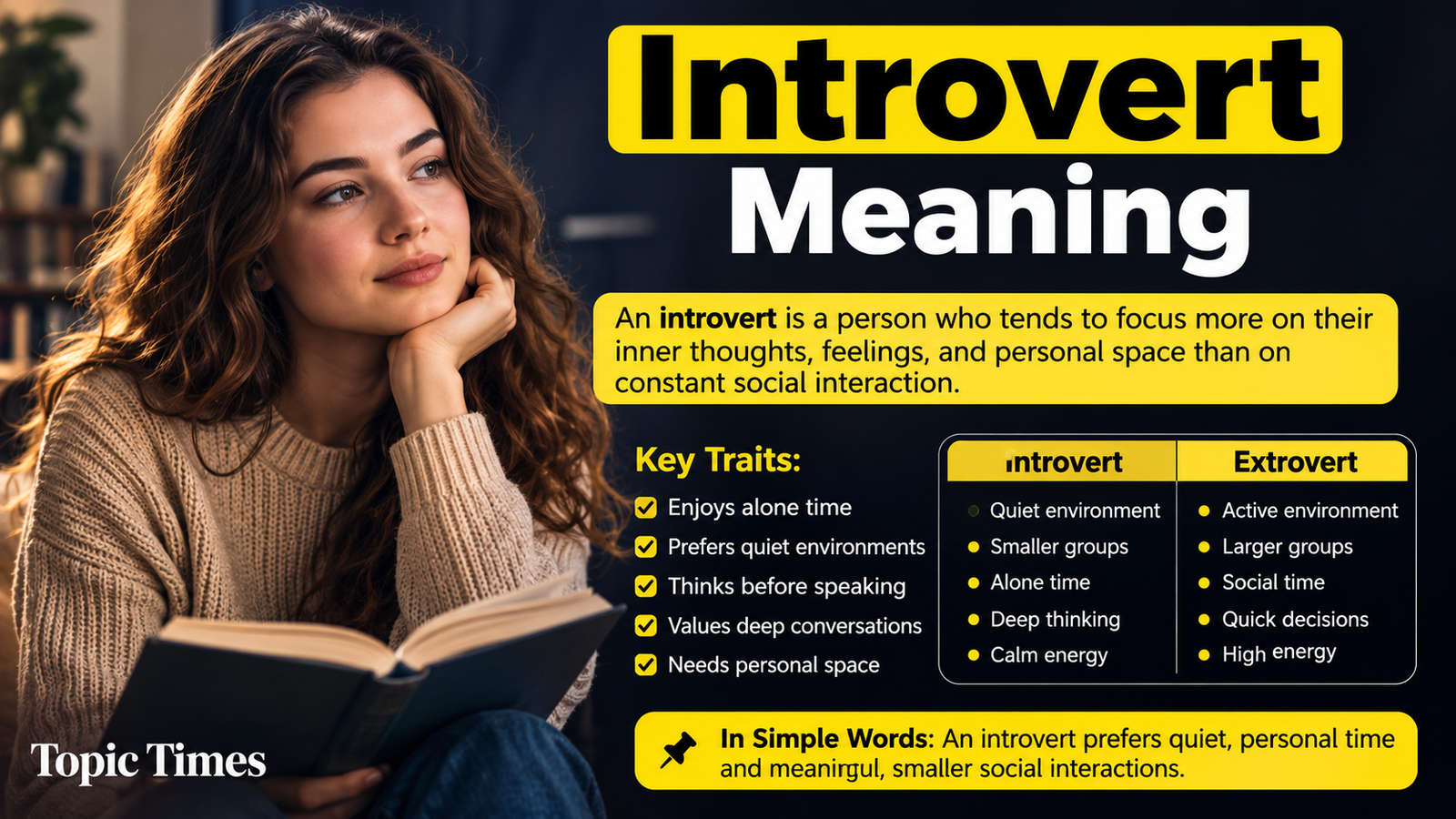
The word introvert describes a person who tends to focus more on their inner thoughts, feelings, and personal space than on constant social interaction. An introvert may enjoy spending time alone, prefer small groups, and need quiet time to recharge after being around many people.
Being an introvert does not mean someone is shy, unfriendly, lonely, or unable to communicate. An introverted person can have strong friendships, speak confidently in public, enjoy social events, and build a successful career. The main difference is often how they feel most comfortable using and restoring their energy.
In this guide, we will explain the introvert meaning in simple English, including its pronunciation, origin, examples, synonyms, antonyms, common usage, and frequently asked questions.
What Is the Meaning of Introvert?
An introvert is a person who generally prefers quieter environments, personal reflection, and smaller or more meaningful social interactions.
In simple words, an introvert often feels most comfortable when they have time to themselves. They may enjoy reading, thinking, writing, listening to music, working independently, or having a deep conversation with one close friend.
For example:
Sarah is an introvert, so she prefers spending a quiet evening at home rather than going to a large party.
The important point is that introversion is about a person’s general social preferences and tendencies. It does not automatically describe their confidence, friendliness, or ability to communicate.
An introvert may happily attend a party but feel tired afterward and want some quiet time. Another introvert may avoid large gatherings because they simply prefer more peaceful settings.
Introvert Meaning in Simple English
The easiest definition is:
Introvert = a person who usually prefers quiet surroundings, personal time, and smaller social interactions.
An introvert often enjoys:
- Spending time alone
- Quiet environments
- Deep conversations
- Small groups
- Independent activities
- Thinking before speaking
- Personal hobbies
- Meaningful relationships
This does not mean every introvert behaves exactly the same way. Introversion exists on a spectrum, and people can have different levels of introverted and outgoing behavior.
How Do You Pronounce Introvert?
The word introvert is pronounced with the stress on the first syllable.
A simple pronunciation guide is:
IN-truh-vurt
The word is commonly used as both a noun and, in some contexts, a verb. In everyday English, however, people most often use it as a noun when describing a person.
Example
She is an introvert.
Here, “introvert” is a noun because it identifies a type of person.
The related adjective is introverted:
He is an introverted person.
Origin and History of the Word Introvert
The history of introvert is surprisingly old.
The verb introvert appeared in English in the 1650s with the basic idea of “turn within” or “direct inward.” It comes from Latin intro, meaning “inward” or “within,” combined with vertere, meaning “to turn.”
The noun introvert was recorded later. Its psychological meaning, referring to an introverted person as opposed to an extrovert, appeared in the early 20th century. The term became particularly associated with the psychological work of Carl Jung.
The related noun introversion, meaning the tendency or quality of turning inward, has roots going back to the 17th century, while its psychological sense developed in the early 20th century.
This history helps explain why the word has such a literal feeling: it originally carried the idea of turning inward.
What Is an Introverted Person Like?
There is no single personality type that describes every introvert. However, introverted people may commonly have certain preferences.
1. They Enjoy Alone Time
Many introverts genuinely enjoy being alone. They may use this time to relax, think, read, watch a movie, pursue a hobby, or simply enjoy silence.
Being alone does not necessarily mean feeling lonely.
2. They Prefer Smaller Groups
An introvert may feel more comfortable talking to two or three close friends than standing in a crowded room full of unfamiliar people.
Small groups can make conversations feel more personal and manageable.
3. They May Prefer Deep Conversations
Some introverts are less interested in constant small talk and more interested in meaningful discussions.
For example, they may enjoy talking about books, personal goals, relationships, ideas, experiences, or future plans.
4. They Often Value Personal Space
Personal space can be important to an introverted person. After a busy day filled with conversations, meetings, or social activities, quiet time may help them feel refreshed.
5. They May Think Before Speaking
Some introverts prefer to process information internally before responding.
This can make them appear quiet during a conversation, even when they are paying close attention.
Introvert Does Not Mean Shy
One of the biggest misunderstandings about the word introvert is that it means shy.
These words are related to different ideas.
Shyness usually involves discomfort, nervousness, or fear in social situations.
Introversion describes a general preference for quieter environments, reflection, and certain types of social interaction.
An introvert can be confident.
For example, a person may be comfortable giving a presentation to hundreds of people but still prefer to spend their free time alone afterward. That person may be introverted without being shy.
Likewise, an extroverted person can sometimes feel nervous in a particular social situation.
Introvert vs. Extrovert
The easiest way to understand introvert meaning is to compare it with extrovert.
An extrovert generally tends to enjoy social interaction, activity, and external stimulation. An introvert generally prefers more internal reflection, quiet, or limited social stimulation.
| Introvert | Extrovert |
|---|---|
| Often enjoys quiet environments | Often enjoys active environments |
| May prefer smaller groups | May enjoy larger social groups |
| Often values alone time | Often enjoys frequent social interaction |
| May think before speaking | May think aloud while talking |
| Can enjoy deep conversations | Can enjoy energetic conversations |
| May need quiet time after socializing | May feel energized by socializing |
These are general tendencies, not strict rules.
A person does not have to fit perfectly into one category.
What Is an Ambivert?
Some people are neither strongly introverted nor strongly extroverted.
They may show characteristics of both. Such a person is often called an ambivert.
The term ambivert was coined in 1927 by psychologist and sociologist Kimball Young to describe someone showing characteristics associated with both introversion and extroversion.
For example, an ambivert might enjoy going to a party with friends on Friday but spend Saturday relaxing alone at home.
This shows why personality is not always black and white.
Common Examples of Introvert in a Sentence
Here are several natural examples of how introvert is used in everyday English.
Example 1
My brother is an introvert, so he enjoys quiet weekends at home.
Example 2
She is an introvert, but she has no problem speaking in front of her class.
Example 3
Being an introvert does not mean that you dislike people.
Example 4
He became more comfortable with his introverted personality as he got older.
Example 5
As an introvert, I prefer having a few close friends rather than a huge social circle.
Example 6
The office was busy, so the introvert on the team took a short break in a quiet room.
These examples show that the word can describe someone’s general personality without suggesting that they are antisocial or unfriendly.
Common Usage of Introvert
The word introvert is common in conversations about personality, relationships, education, work, and social behavior.
You may see phrases such as:
- I am an introvert.
- She is a natural introvert.
- He has an introverted personality.
- Introvert behavior
- Introvert meaning
- Introvert vs. extrovert
- Introvert personality
- A quiet introvert
- Introvert social life
The adjective introverted is also widely used.
For example:
He has an introverted personality.
She is naturally introverted.
The noun introvert refers to the person, while introverted describes a characteristic or behavior.
Introvert Synonyms
There is no perfect synonym for introvert, because the word has a specific psychological and personality-related meaning. However, depending on the context, related words include:
- Quiet person
- Reserved person
- Private person
- Reflective person
- Retiring person
- Solitary person
- Thoughtful person
- Self-contained person
These words are not always interchangeable.
For example, quiet simply means someone does not talk much, while introvert describes a broader personality tendency.
Similarly, solitary can suggest someone who spends a lot of time alone, but it does not necessarily mean that person is an introvert.
Introvert Antonyms
The most common antonym of introvert is extrovert.
Other context-dependent opposites include:
- Outgoing person
- Sociable person
- Gregarious person
- Outgoing personality
- Social person
An extrovert is generally described as someone who is more outwardly focused and comfortable with frequent social interaction.
The word extrovert itself comes from a German psychological term and ultimately connects with Latin extra, meaning “outside,” and vertere, meaning “to turn.”
Is Being an Introvert a Bad Thing?
No. Being an introvert is not inherently good or bad.
Introversion is simply one way people can differ in how they interact with their environment and other people.
An introverted person can be successful in business, education, leadership, entertainment, science, or almost any other field.
In fact, qualities often associated with introversion can be useful in many situations. A person who likes to reflect carefully may take time to consider a difficult decision. Someone who enjoys listening may notice details that others miss.
The important thing is not whether someone is an introvert or extrovert. What matters is understanding your own personality and finding environments where you can function comfortably and effectively.
Are Introverts Antisocial?
No.
Introvert and antisocial do not mean the same thing.
An introvert can enjoy friendships, family gatherings, teamwork, dating, travel, and social events.
The difference is often in the amount and type of social interaction they prefer.
The word antisocial is sometimes incorrectly used in everyday conversation to describe someone who does not want to socialize. In more precise usage, it has a very different meaning.
So calling every quiet person “antisocial” is inaccurate.
Introvert Meaning in Relationships
Introverts can have deep and meaningful relationships.
They may prefer quality over quantity when it comes to friendships. Instead of having a large group of acquaintances, an introvert may develop a small number of close relationships.
An introverted partner may also appreciate quiet activities such as watching a movie together, cooking at home, taking a walk, or having a long conversation.
However, introversion does not determine how someone behaves in a relationship. Every individual has different needs, communication habits, and emotional preferences.
Introvert Meaning at Work
Being introverted does not prevent someone from becoming a strong professional.
An introverted employee may enjoy independent projects, focused work, writing, research, planning, or one-to-one discussions.
At the same time, an introvert can learn to participate effectively in meetings, presentations, interviews, and networking events.
A useful workplace approach is to recognize that being less talkative does not mean having fewer ideas.
Someone may simply prefer to think carefully before contributing.
Introvert Meaning on Social Media
The word introvert is frequently used online.
People may describe themselves as introverts when discussing:
- Staying home instead of going out
- Avoiding crowded events
- Enjoying quiet weekends
- Needing alone time
- Preferring online conversations
- Feeling drained after large gatherings
- Enjoying books, games, movies, or personal hobbies
Social media sometimes turns “introvert” into a humorous personality label. Memes may portray introverts as people who never leave their rooms or dislike everyone.
These jokes can be entertaining, but they should not be treated as a complete definition of introversion.
Signs Someone May Be Introverted
A person may have introverted tendencies if they frequently:
- Enjoy spending time alone.
- Prefer smaller gatherings.
- Need quiet time after social events.
- Like working independently.
- Think carefully before speaking.
- Prefer meaningful conversations.
- Feel comfortable entertaining themselves.
- Value a small circle of close relationships.
- Enjoy calm environments.
- Reflect deeply on experiences.
These are only possible tendencies. They are not a test or diagnosis.
Frequently Asked Questions About Introvert Meaning
What does introvert mean in simple words?
An introvert is a person who generally prefers quiet settings, personal time, and smaller or meaningful social interactions.
Is an introvert a shy person?
Not necessarily. Introversion and shyness are different concepts. An introvert can be confident and socially skilled while still preferring quiet environments.
What is the opposite of introvert?
The most common opposite of introvert is extrovert. An extrovert generally enjoys more frequent social interaction and outward activity.
Can an introvert have friends?
Yes. Introverts can have close friendships and strong relationships. They may simply prefer a smaller number of meaningful connections.
Is introvert a positive or negative word?
Introvert is a neutral word. It describes a personality tendency rather than a positive or negative quality.
What is the difference between introvert and introverted?
Introvert is usually a noun referring to a person. Introverted is an adjective describing someone’s personality or behavior.
For example:
She is an introvert.
She has an introverted personality.
What does introvert mean in texting?
In texting and social media, introvert usually has the same basic meaning: someone who prefers limited social interaction, quiet time, or smaller social circles. Online, the word is also sometimes used casually or humorously.
Can an introvert become an extrovert?
People can change their behavior and become more comfortable with social situations, but personality tendencies are not simply a switch that turns from one side to the other. Many people also display both introverted and extroverted characteristics depending on the situation.
Final Thoughts on Introvert Meaning
The introvert meaning is much simpler than many people assume. An introvert is generally a person who prefers inward reflection, quiet environments, personal space, and certain types of social interaction.
Being an introvert does not automatically mean being shy, lonely, antisocial, or unfriendly. An introverted person can be confident, successful, funny, ambitious, and highly social when the situation calls for it.
The word itself has a long history. Its roots connect to the Latin idea of turning inward, while its modern psychological meaning developed during the early 20th century.
Ultimately, introversion is one part of personality. Some people prefer a quiet room and one meaningful conversation; others enjoy a crowded room filled with new faces. Many people fall somewhere between those two extremes.
Understanding the word introvert therefore means more than simply saying “someone who likes being alone.” It is about recognizing that people have different ways of experiencing social interaction, restoring their energy, communicating, and connecting with the world around them.